What It Would Take for Your Portfolio to Replace Your Paycheck


On this page
Imagine an investor named Maya. She has spent years building a $900,000 portfolio, earns $160,000 a year, and invests another $40,000 every year. She has done a lot right.
But she still can't answer the question that matters to her: When can work become optional?
Searching for a magic portfolio number won't answer it. Neither will trying to replace her $160,000 salary dollar for dollar. Her portfolio needs to fund what she actually spends after accounting for other dependable income. Then it needs to keep doing that through inflation, market declines, and a future that won't follow a spreadsheet neatly.
The useful answer is a range. To build it, we need to connect four things: the life you want to fund, the capital you have, the time available, and the uncertainty you have to live with.
Your portfolio doesn't need to replace your gross salary
A paycheck pays for more than your lifestyle. Part of it may go to taxes, retirement contributions, payroll deductions, and savings. If you earn $160,000 but invest $40,000, using the full salary as your spending target immediately overstates what the portfolio must provide.
Start with spending instead. How much money would need to leave your accounts each year if the paycheck stopped?
Taxes still belong in the calculation, but there isn't one adjustment that works for everyone. The amount depends on where you live, the type of account you withdraw from, the source of the return, and your other income. Estimate your after-tax spending need, then work backward to the gross withdrawals your own circumstances require. A qualified tax professional can help with that part.
This shift from salary to spending usually gives you a better number. More importantly, it gives you a number connected to the life you are trying to fund.
Price the life you want in today's money
I would build the annual target in three parts:
- Essential spending: housing, food, insurance, utilities, healthcare, and the bills you intend to keep paying in almost any market.
- Discretionary spending: travel, hobbies, gifts, restaurants, and other spending you could reduce temporarily without disrupting the basics of your life.
- Irregular spending: home repairs, replacing a car, family support, and large healthcare costs that don't arrive as a clean monthly bill.
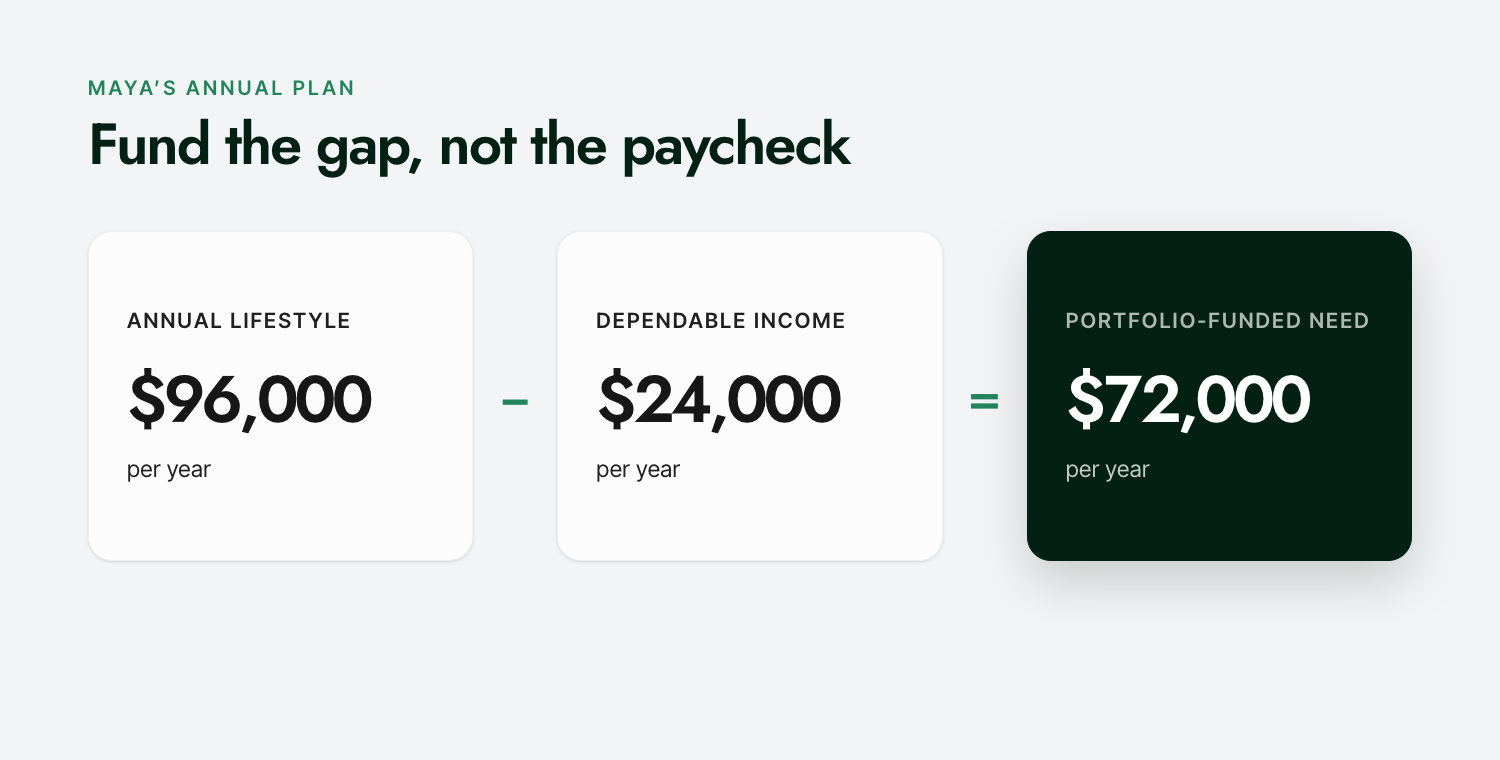
Suppose Maya estimates $60,000 of essential spending, $24,000 of discretionary spending, and an average of $12,000 a year for irregular expenses. Her life costs $96,000 a year in today's purchasing power.
Now subtract income she can reasonably depend on. If she expects $24,000 a year from a durable outside source once she stops working, her portfolio must provide $72,000.
That outside income needs the same scrutiny as the spending. A contractual pension is different from occasional consulting work. Rental income can stop during a vacancy and come with repair costs. Government benefits can begin at a different age from the one when you want to leave work. Count each source when it starts, estimate it after relevant costs and taxes, and don't treat income you merely hope to earn as dependable.
Turn annual spending into a capital range
A withdrawal rate is the percentage of the starting portfolio you plan to withdraw in the first year. A simple first estimate divides annual portfolio-funded spending by that rate.
Using Maya's $72,000 target, here is an illustration:
- At a 4% initial withdrawal rate, the capital target is $1.8 million.
- At a 3.5% initial withdrawal rate, the target is about $2.06 million.
- At a 3% initial withdrawal rate, the target is $2.4 million.
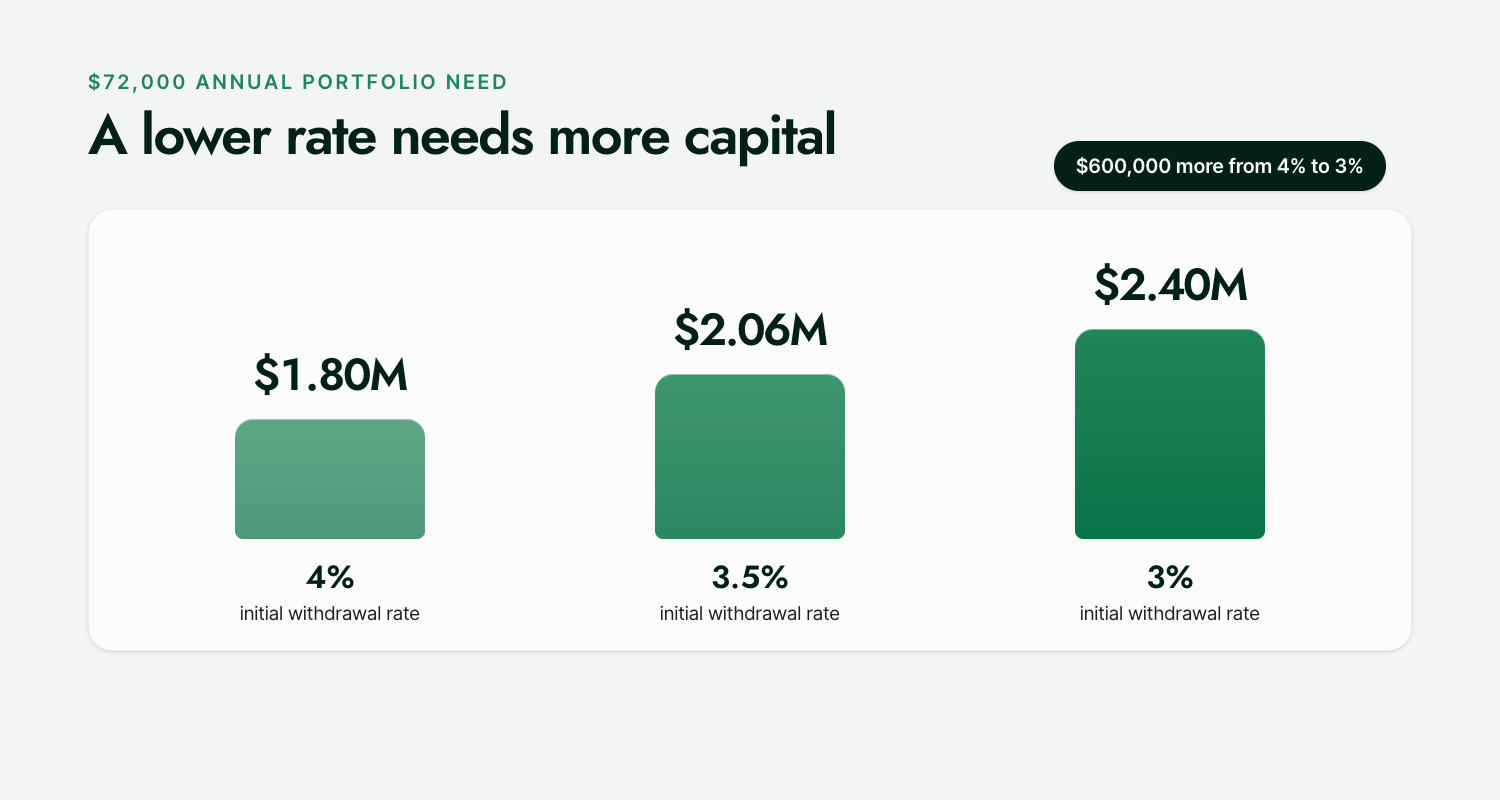
The lower rate requires more capital because each dollar of the portfolio is being asked to support less first-year spending. Moving from 4% to 3% raises Maya's target by $600,000 even though her lifestyle hasn't changed.
These figures are planning assumptions, not three levels of guaranteed safety. The right range depends on the length of the withdrawal period, portfolio mix, fees, taxes, spending flexibility, and what markets do while withdrawals are happening. Research such as Morningstar's annual retirement-income studies tests withdrawal rates under stated assumptions, but no historical or modeled rate covers every future path.
So don't ask which percentage is universally safe. Ask which capital range remains workable under assumptions you can defend, and what you would change if experience is worse than planned.
Map your current portfolio to the target
Now we can connect today's portfolio to the range.
For a model stated in today's purchasing power, use a real return, meaning the return after inflation. If you use a nominal return instead, you also need to inflate future spending and the capital target. Mixing a nominal portfolio value with today's spending is one of the easiest ways to make a plan look stronger than it is.
The real-value calculation has two parts:
- Grow the capital already invested for the years remaining.
- Add the future value of each contribution, allowing earlier contributions more time to compound than later ones.
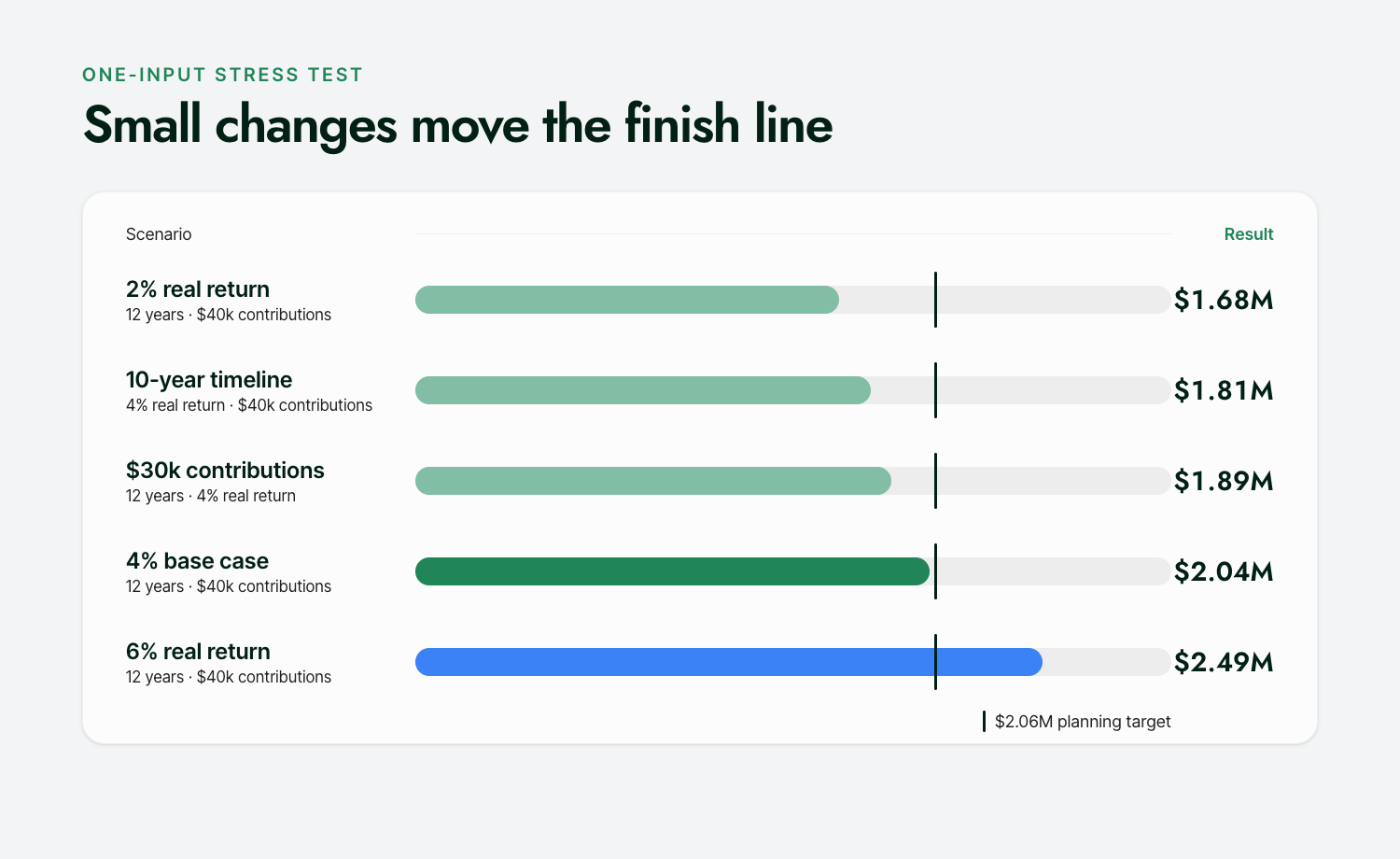
Suppose Maya has 12 years, starts with $900,000, and adds $40,000 at the end of each year. We will assume those contributions rise with inflation, so they remain $40,000 in today's purchasing power. At an illustrative 4% annual real return, the model produces about $2.04 million in today's money after 12 years.
That puts her close to the $2.06 million target created by a 3.5% initial withdrawal assumption. Because the projection leaves almost no room for error, the assumptions behind it now deserve careful testing.
Write them beside the result:
- Starting invested capital: $900,000
- Annual contribution: $40,000 in today's money
- Time: 12 years
- Real annual return: 4%, before any personal tax effects not already reflected
- Annual portfolio-funded spending: $72,000 in today's money
- Initial withdrawal assumption: 3.5%
A forecast you can't explain isn't a plan. Visible assumptions let you see why the number changes.
Find the assumption doing the most work
A base case can hide a weak plan because every input gets to behave at the same time. Stress-test one variable at a time before combining difficult conditions.
Keeping Maya's starting capital, contributions, and 12-year timeline unchanged, a 2% real return produces about $1.68 million. A 6% real return produces about $2.49 million. That spread tells us the result is highly sensitive to a return nobody can know in advance.
Now hold the 4% real return steady and change another input. Reducing annual contributions from $40,000 to $30,000 lowers the 12-year result to about $1.89 million. Shortening the timeline from 12 years to 10 lowers it to about $1.81 million.
The point isn't to choose the most comforting version. It is to find out what the plan quietly requires.
If the plan only works at 6% above inflation, future returns are doing most of the work. If it fails after one year of missed contributions, the savings schedule is fragile. If a modest spending change moves the goal much more than a return change, spending is the stronger lever.
Test the assumptions separately first. Then test a difficult combination, such as lower returns, one interrupted year of contributions, and higher essential spending. Real life rarely changes one input at a time.
The return you need isn't the return you should expect
A spreadsheet can solve for the return required to reach a target. It can't make the market provide it.
In Maya's case, reaching roughly $2.06 million from $900,000 while adding $40,000 a year for 12 years requires about a 4.1% annual real return under the timing assumptions above. That is useful information. We can now judge whether the plan depends on a plausible return rather than choosing a return just because it closes the gap.
Long-term evidence can help anchor that judgment. The UBS Global Investment Returns Yearbook 2024 reports that worldwide equities produced an annualized real return of about 5% from 1900 through 2023. That long history includes severe losses, and it is not a forecast for Maya's next 12 years. A diversified portfolio that also holds lower-risk assets would have a different expected return and risk profile. Fees and taxes can reduce what the investor keeps.
I would use evidence like this as a reasonableness check, not permission to plug 5% into every plan. Compare several reputable forward-looking capital-market assumptions, understand what portfolio each one describes, and use a range. Keep the return after fees and consistent with inflation.
Taking more risk also doesn't reliably repair a shortfall. More exposure to risky assets can raise expected return, but it widens the range of possible outcomes and can deepen losses at the worst time. If your plan requires a return your portfolio isn't reasonably expected to deliver, the honest conclusion is that another lever has to change.
Test the path, not only the destination
Average return hides the order in which returns arrive. That order matters once money is leaving the account.
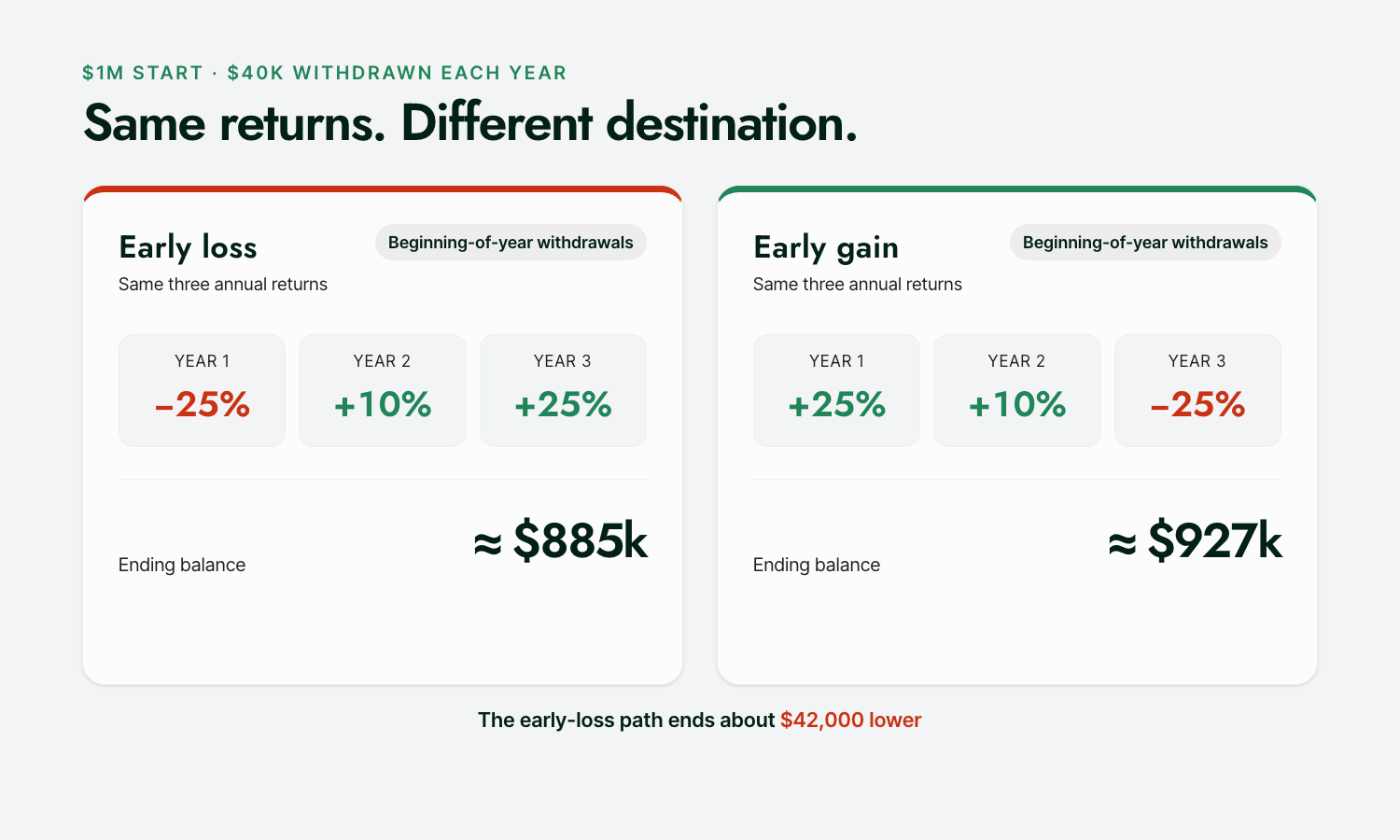
Consider a simplified three-year illustration. Two $1 million portfolios each withdraw $40,000 at the beginning of every year. Both experience the same three returns, but in a different order. We will ignore taxes and fees here so the effect is easy to see.
The first portfolio earns -25%, then 10%, then 25%. It ends with about $885,000 after the withdrawals. The second earns 25%, then 10%, then -25%. It ends with about $927,000.
Without withdrawals, the order would not change the ending value. With withdrawals, the early loss forces the first investor to remove money from a smaller base. Less capital remains to participate in the recovery. This is sequence-of-returns risk, and it becomes especially important near the start of retirement.
The same plan should also survive questions the average-return forecast doesn't answer:
- What if inflation stays high while essential spending rises?
- What if you can't contribute for a year because of a job loss or family need?
- What if a home repair requires cash during a market decline?
- What spending could you pause, and what spending cannot wait?
- How much readily available cash would keep you from selling long-term investments for a near-term bill?
A plan can reach its average destination on paper and still fail along the way. Your liquidity reserve, spending flexibility, and response to a drawdown are part of the design.
If you want a plain-language look at how investment decisions fit together, you can read my free book, The 5-Minute Hedge Fund.
Close the gap with decisions you control
When the range and projection don't meet, work through the levers in an order that separates decisions from hopes.
First, review spending. Separate the life you want from a permanently fixed number. Identify what is essential, what is flexible, and which irregular costs need their own funding.
Second, review savings. An extra dollar contributed is under your control in a way that an extra percentage point of market return is not. Check whether a higher contribution is realistic without making the present miserable.
Third, review the timeline. Another year can add a contribution, give existing capital more time to compound, and shorten the period the portfolio must fund. It can be a powerful lever, but it still needs to fit your health, work, and family circumstances.
Fourth, review dependable outside income. Part-time work, a pension, or another source may reduce early withdrawals. Be honest about when the income starts, how reliable it is, and whether continuing to earn it is compatible with the life you want.
Fifth, review portfolio risk. Choose risk because it fits the goal, timeline, and ability to withstand loss, not because the spreadsheet needs a higher return. A shortfall is not evidence that you can safely take more risk.
Finally, define flexibility before you need it. Decide what you would do after a major decline, an inflation surprise, or a change in health. You might delay leaving work, earn some temporary income, reduce discretionary spending, or lower a planned irregular expense. A contingency chosen calmly is easier to follow than one invented during a falling market.
Write those decisions into a short policy and review it at a set time each year. Update the portfolio, spending, outside income, and timeline. Revisit sooner after a major life change, not after every bad week in the market.
Your investments don't replace a paycheck when they reach one magic number. They replace the part of your life that needs funding when a reasonable range of capital, a credible set of assumptions, and a workable response to difficult conditions all fit together.
That is the answer worth having. You know what the goal demands, which levers matter most, and whether the plan still works without asking future returns to rescue it.
Hey, I'm Sean. I run Predicting Alpha, where I help people beat the market without turning it into a second job. I've helped 3,000 traders, and I write these articles to explain what matters for your portfolio in plain language.
If you found this useful, follow along. I share more like this here.
P.S. I reply to all comments personally, so feel free to leave your questions below.