Ten Years From Retirement: How to Shift From Building Wealth to Funding a Life


On this page
For most of your working life, retirement planning can feel like a race toward one number. You save, invest, and check whether the account is getting closer to the target.
Then you get within ten years of retirement and the question changes.
That account will soon have to help pay for groceries in year one, a new roof in year six, and whatever life costs in year twenty-five. The spending has to continue through good markets, bad markets, and years when prices rise faster than expected.
Reaching a number on your retirement date is only part of the job. The bigger job is turning what you have built into a dependable way to fund your life.
Ten years gives you time to design that transition before the first paycheck disappears. It does not create a universal deadline for selling stocks or buying a particular mix of investments. Your retirement date, spending, other income, and flexibility should determine what changes.
Start with the life the portfolio has to fund
I would not begin by asking whether you should own 50%, 60%, or 70% in stocks. Those percentages have no useful context until we know what the money needs to do.
Start with your expected retirement date and build a simple annual spending estimate in today's dollars. Separate essential expenses, such as housing, food, utilities, and healthcare, from discretionary spending, such as travel and gifts. That distinction matters because a plan with flexible travel spending can respond to a bad market more easily than a plan in which nearly every dollar is committed.
Then list the reliable income you expect outside the portfolio. Depending on where you live and what you have earned, that could include a public pension, employer pension, annuity income, rental income, or part-time work. Be conservative about income that is uncertain.
The difference between spending and reliable outside income is the amount the portfolio must fund.
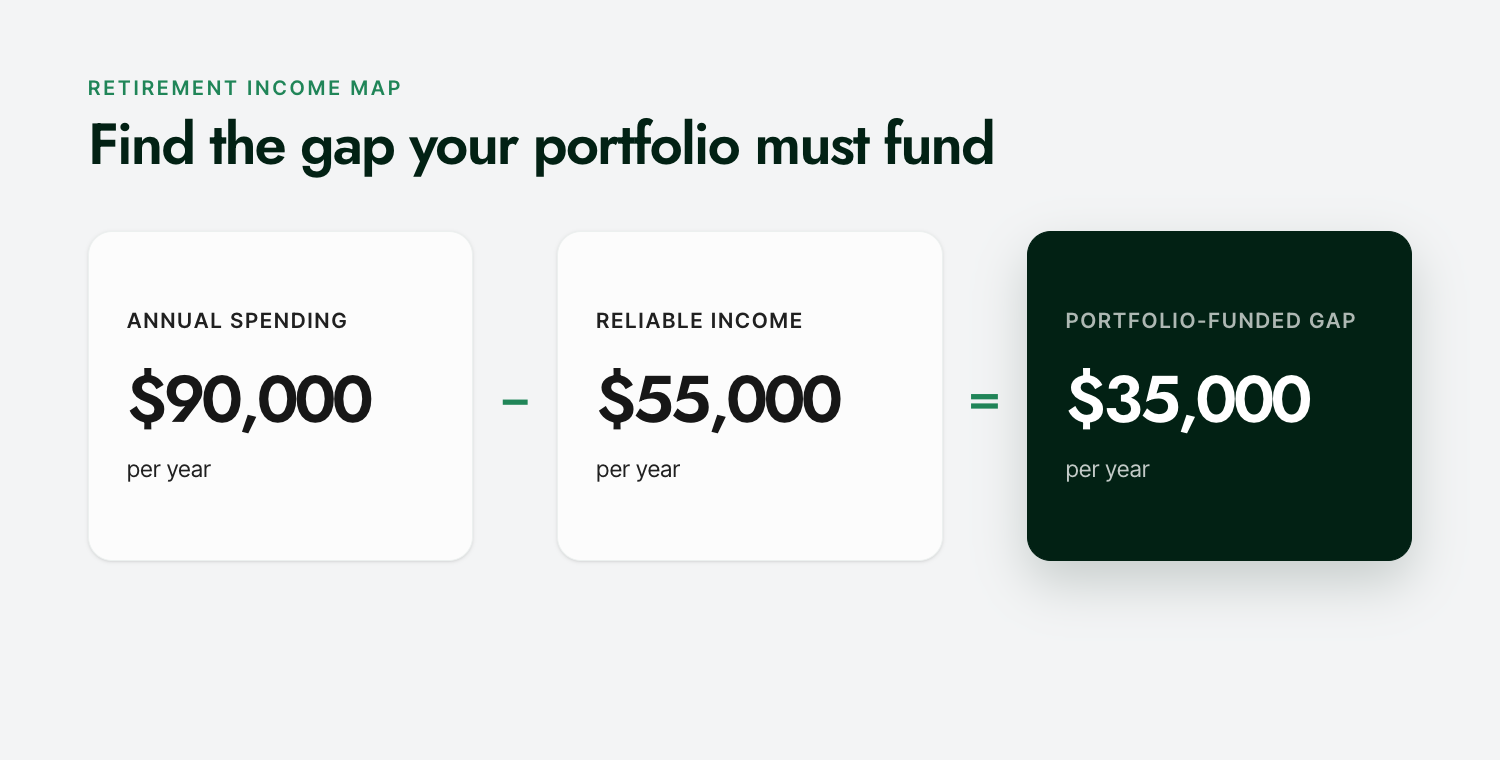
Suppose you expect to spend $90,000 a year and receive $55,000 from reliable sources. Your portfolio is not being asked to produce the full $90,000. It needs to cover a $35,000 annual gap, plus taxes and any costs not already included in your estimate.
Now add the expenses that do not fit neatly into an annual budget. A home renovation, help for an adult child, a vehicle replacement, or a move can create a large cash need at a specific time. Add your desired liquidity for emergencies and any money you genuinely intend to leave behind.
You now have a much better description of the portfolio's new job:
- Cover an estimated annual spending gap.
- Keep known near-term expenses available when they are due.
- Retain enough growth potential for spending that may continue for decades.
- Preserve any legacy amount that is separate from your own retirement needs.
That description tells us far more than your age alone.
Why the order of returns starts to matter
While you are working and contributing, a market decline can be uncomfortable, but you are usually not forced to sell investments to fund your life. You may even be buying more at lower prices.
Withdrawals change the mechanics. When you sell after a decline, the money you remove is no longer invested for the recovery. That is sequence-of-returns risk: the order in which gains and losses arrive can affect how long a portfolio lasts, even when the returns over a period look similar.
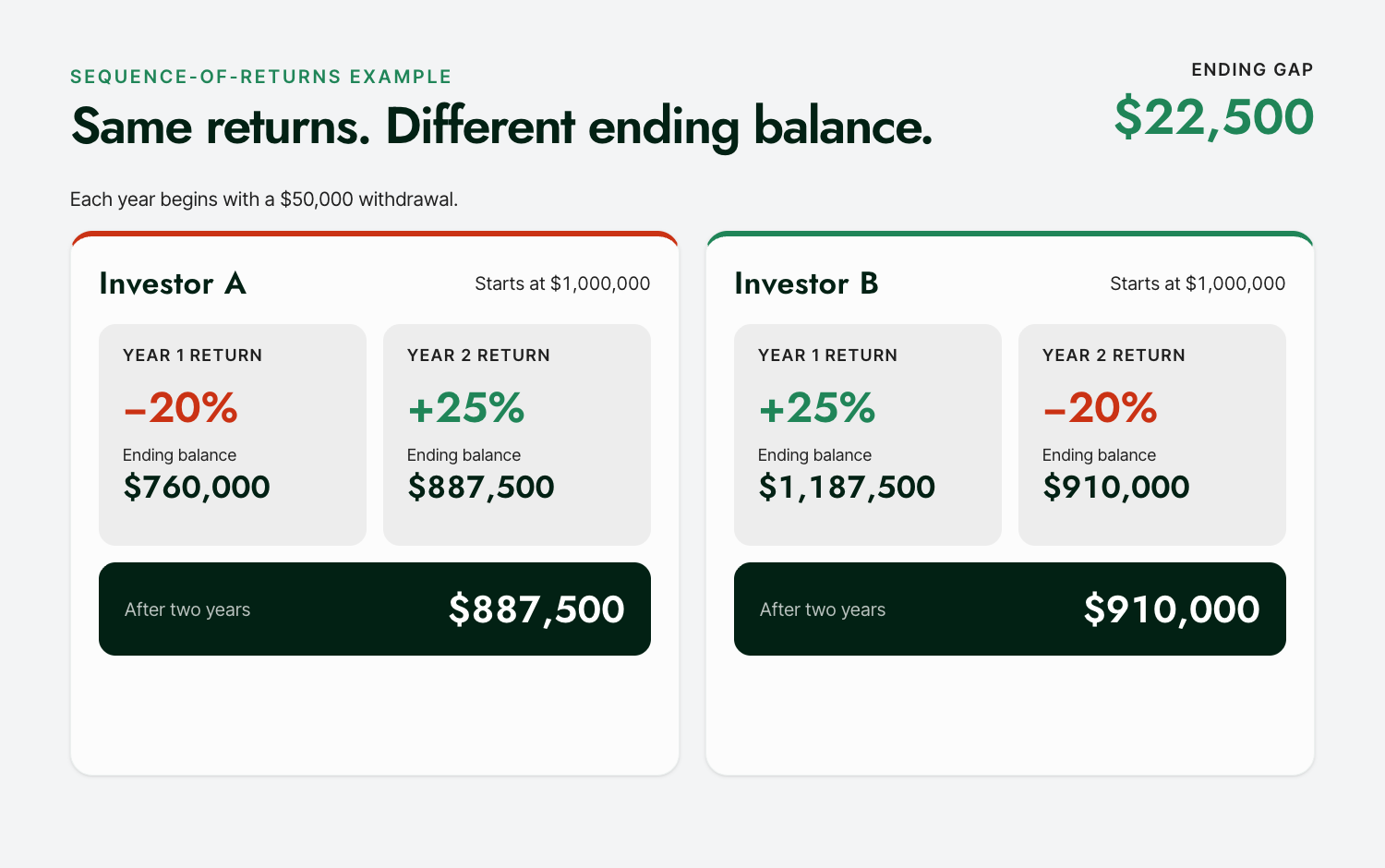
Here is a simplified two-year illustration. Both investors start with $1 million and withdraw $50,000 at the beginning of each year. There are no taxes or fees.
- Investor A withdraws $50,000, then the portfolio loses 20%. It ends year one at $760,000. After the next $50,000 withdrawal and a 25% gain, it ends year two at $887,500.
- Investor B withdraws $50,000, then the portfolio gains 25%. It ends year one at $1,187,500. After the next $50,000 withdrawal and a 20% loss, it ends year two at $910,000.
The two annual returns are identical. Only their order changed. Without withdrawals, a 20% loss followed by a 25% gain returns the portfolio to its starting value, and the reverse order does the same. With withdrawals, the early loss leaves Investor A with $22,500 less after only two years.
This is a small teaching example, not a retirement forecast. It shows why an average return assumption cannot describe the whole experience once spending begins.
William Bengen's 1994 research on historical withdrawal rates helped establish this point by examining how withdrawals survived across different historical market sequences, rather than relying only on one average return. The exact withdrawal rate that works in the future cannot be known in advance, but the mechanism is clear: poor returns early in retirement can do more damage than the same poor returns arriving later.¹
Sequence risk is only one part of the problem. Inflation can make the same lifestyle more expensive over time. Longevity risk is the possibility that your money needs to support you longer than expected. Holding more cash can reduce exposure to an immediate market sale, but too much cash can make inflation and longevity harder to manage. No portfolio removes every risk. The work is deciding which risks you can bear and how you will respond when one shows up.
Give each part of the portfolio a job
A useful way to organize the portfolio is by what the money is there to do. This does not require three separate accounts, and it does not imply one correct number of years in each group. It gives you a way to judge whether the pieces fit the plan.
Near-term spending capacity. This is money intended to cover upcoming withdrawals and known expenses without depending on the stock market being up on the date you need it. Cash and high-quality short-term fixed-income investments may serve this role. The benefit is availability and stability. The cost is lower expected growth, along with the risk that inflation reduces what the money can buy.
Stabilizing exposures. High-quality bonds and other appropriate defensive holdings can reduce how much the total portfolio moves and provide assets that may be available for rebalancing or withdrawals during a stock-market decline. They still carry risk. Interest-rate changes, inflation, and credit problems can all produce losses, so the label “defensive” does not mean guaranteed.
Long-horizon growth. Diversified stock exposure can help the portfolio keep up with decades of spending and rising prices. Its role is long-term growth, not next year's grocery bill. The cost is accepting that its value can fall sharply, sometimes when retirement is close.
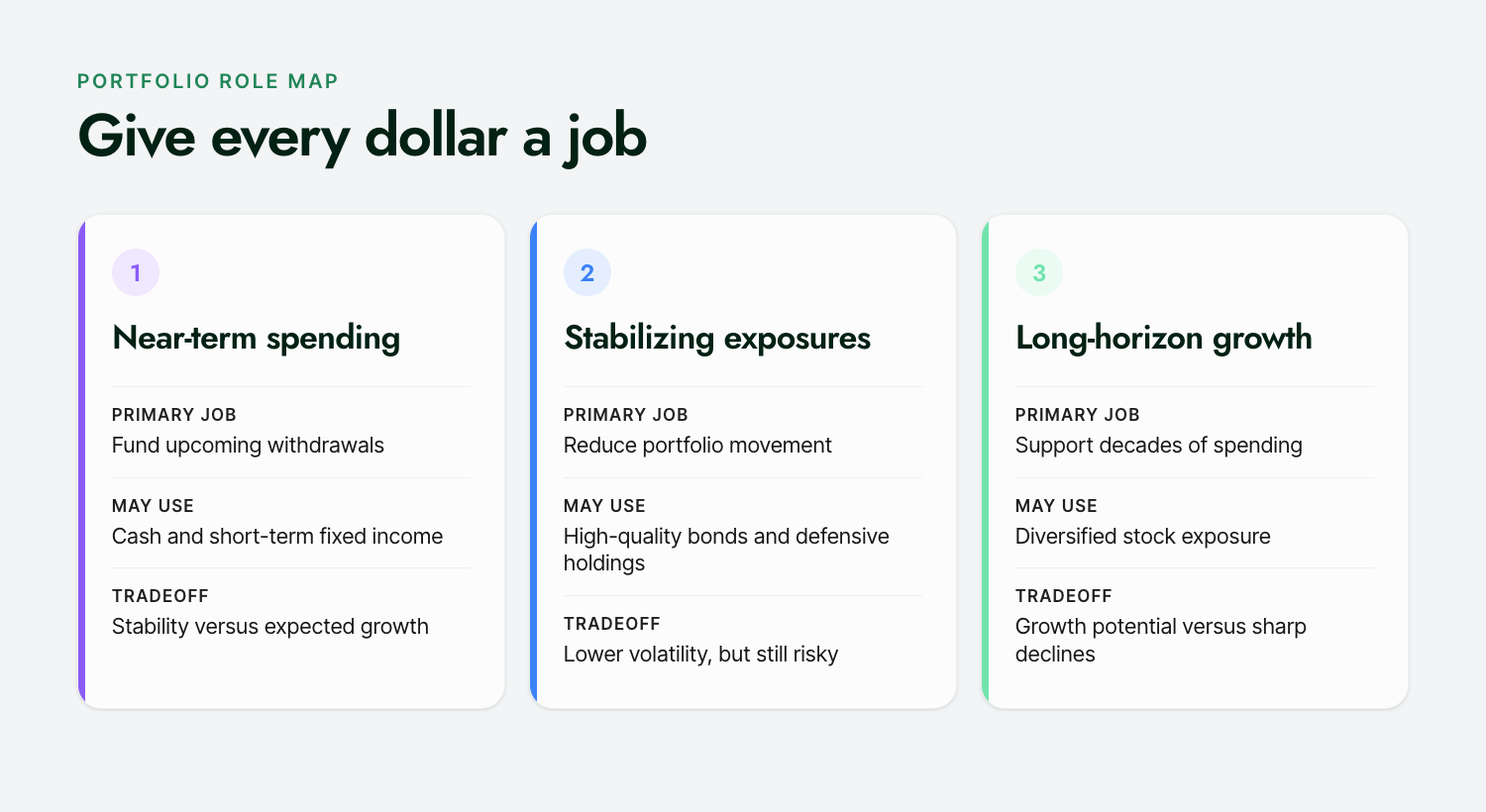
The tradeoff becomes easier to see once every dollar has a job. More near-term stability can make the next few years easier to fund, but it may reduce long-run growth. More growth exposure can improve the portfolio's long-term potential, but it raises the chance that a large loss collides with the first withdrawals.
Your allocation should reflect that tension rather than hide it behind a rule based only on age.
If you want a practical way to think about how the pieces of a portfolio work together, I explain our broader approach in my free book, The 5-Minute Hedge Fund.
Decide how much risk the plan needs and can survive
Risk tolerance is often treated as one emotional score. A retirement plan needs three separate questions.
How much risk do you need? If reliable income covers most of your spending and the portfolio is large relative to the remaining gap, you may not need aggressive return assumptions. If the plan works only after assuming unusually high returns, the problem may be the spending target, retirement date, savings rate, or portfolio size rather than an allocation that is too cautious.
How much risk can you afford? This is your financial ability to live through a loss. Someone who can delay retirement, work part-time, or reduce discretionary spending has more room to adjust than someone with a fixed retirement date and little flexible spending.
How much risk will you actually tolerate? A plan you abandon during a decline is not a workable plan. Think in dollars, because a percentage on a questionnaire rarely feels like a real account statement.
Here is an illustrative stress test. Assume you have a $1 million portfolio, the portfolio must provide $50,000 in the coming year, and the total portfolio falls 25%. Its value is now $750,000. After a $50,000 withdrawal, $700,000 remains. Ignoring future withdrawals, it would then need to gain about 42.9% to return to the original $1 million.
The purpose of this illustration is not to predict a 25% decline or say the whole portfolio should share the same loss. A portfolio with dedicated near-term spending assets would behave differently. The point is to make the consequences concrete.
Ask what you would do in that situation. Could the planned withdrawal still happen without selling depressed growth assets? Would you delay retirement by a year? Could you temporarily cut travel or another discretionary expense? How many years of recovery can the plan reasonably allow? Would a $250,000 account decline cause you to sell everything?
If the answers reveal a plan you cannot finance or follow, change it now. That could mean saving more, retiring later, spending less, holding more near-term spending capacity, or accepting a different legacy goal. The allocation is one lever, not the only lever.
Move gradually instead of betting on one forecast
Once you know the portfolio's new job, write a transition policy. The policy should tell you how the current allocation moves toward the target without requiring you to predict the best day to make one enormous trade.
New contributions can build underweight parts of the portfolio. Dividends and interest can be directed toward near-term spending capacity. Rebalancing can trim positions that have grown beyond their intended role and add to those below target.
You can also decide in advance how the allocation will change. A scheduled policy might make modest adjustments at set annual reviews as retirement approaches. A threshold policy might trigger rebalancing when an asset group moves a specified distance from its target. Some investors may combine the two.
The details should fit the plan. What matters is that the transition is driven by your spending horizon and written rules, rather than a prediction about next month's market.
Gradual does not mean endlessly postponing necessary changes. If money for a known expense is still exposed to a loss you cannot afford, the plan needs attention. The goal is to avoid replacing one risk with another by making the entire retirement transition depend on a single forecast.
Write the withdrawal rules before you need them
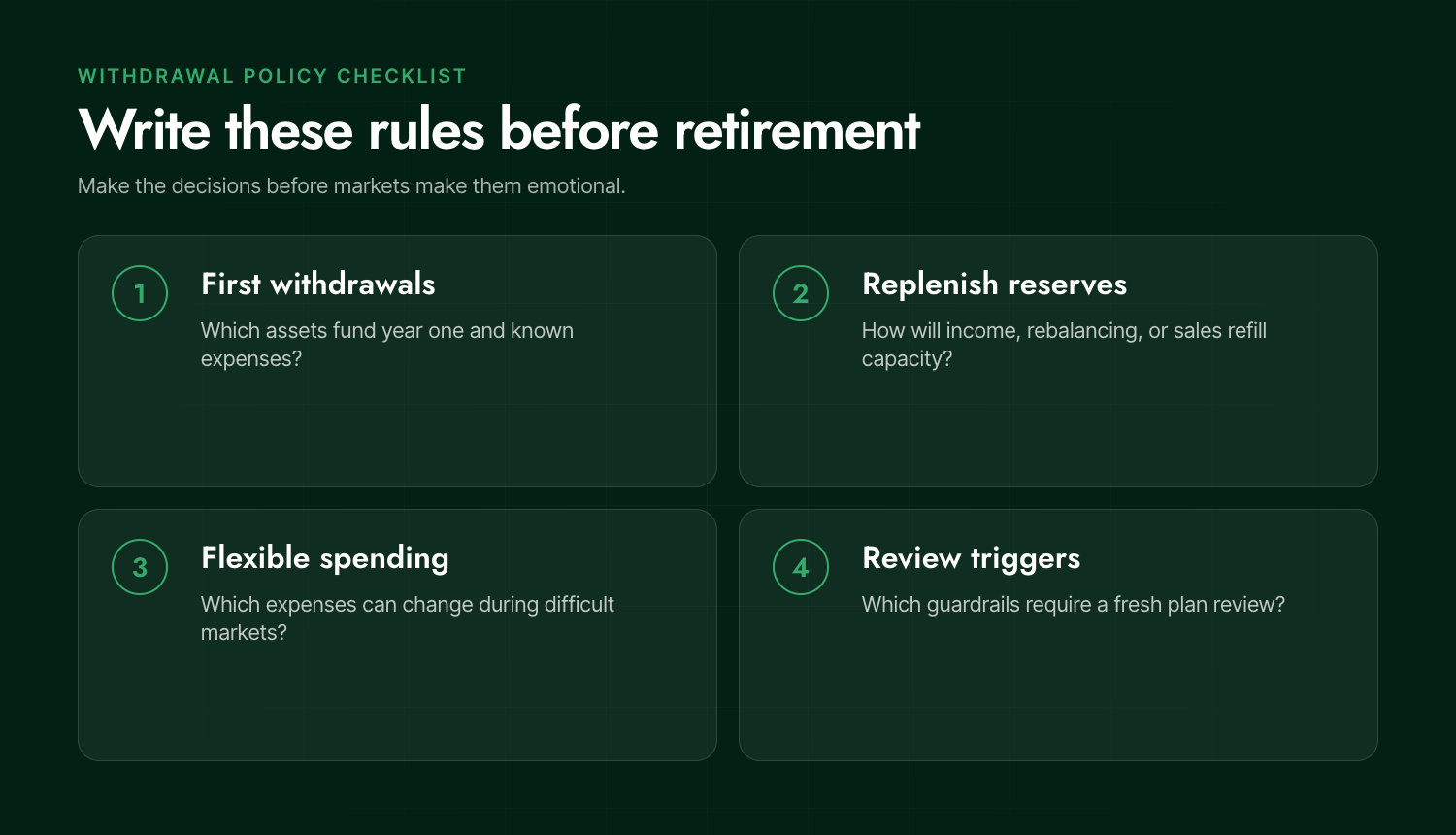
A retirement allocation is incomplete without instructions for taking money out. Before retirement, settle four operating decisions.
- Where will the first withdrawals come from? Identify the assets intended to fund the first year and any large known expenses.
- How will you replenish that spending capacity? You might use income from the portfolio, rebalance after strong markets, or sell according to predetermined allocation rules.
- What spending can change? Define which expenses could be reduced temporarily and which ones must be paid regardless of market conditions.
- What triggers a review? Set guardrails for a portfolio decline, an unsustainably high withdrawal relative to the remaining balance, depleted near-term reserves, or a major change in the plan.
These rules should also account for taxes and the types of accounts you own. The right withdrawal order can depend on your country, account structure, tax rates, age, estate plans, and changing law. Treat that as individual planning work, not a universal sequence copied from an article.
A written policy gives you something to follow when markets are frightening and every headline feels urgent. It also gives you something to improve after you see how retirement spending actually develops.
Change the plan when your life changes
Review the plan on a regular schedule, such as annually, and after a material life event. The purpose of a review is to investigate whether the assumptions or needs changed.
A higher spending estimate, a later pension start, a health issue, a new family obligation, or an earlier retirement date can all change what the portfolio must fund. So can a major change in expected inflation, investment costs, taxes, or reasonable long-term return assumptions.
An ordinary market headline is different. Markets will produce elections, recessions, rallies, selloffs, and confident forecasts every year. A headline alone does not tell you that your retirement objective changed or that the portfolio can no longer do its job.
Use the review to compare actual spending with the plan, update outside income, check the allocation against its intended roles, and rerun the difficult-path test. If something material changed, revise the policy. If nothing material changed, following the policy is usually more useful than improvising around the news.
The real shift starts before retirement
Being ten years from retirement does not give you a magic stock-and-bond mix. It gives you a valuable window to change the way you think about the portfolio.
Define the spending gap it must cover. Separate money by job. Test losses in dollars and decide which adjustments you could live with. Then write the transition and withdrawal rules while employment income still gives you room to correct mistakes.
You are no longer investing only to reach a number. You are preparing the money to fund a life, and that job deserves a plan before the first withdrawal arrives.
¹ William P. Bengen, “Determining Withdrawal Rates Using Historical Data,” Journal of Financial Planning, October 1994.
Hey, I'm Sean. I run Predicting Alpha, where I help people beat the market without turning it into a second job. I've helped 3,000 traders, and I write these articles to explain what matters for your portfolio in plain language.
If you found this useful, follow along. I share more like this here.
P.S. I reply to all comments personally, so feel free to leave your questions below.