A Great Company Can Still Be a Bad Investment


On this page
A company earns $1 per share. Over the next five years, earnings per share grow by 20% a year. By the end, it earns about $2.49 per share.
That is an exceptional business result. Earnings have nearly multiplied two and a half times.
Now imagine you paid 40 times earnings for the shares, or $40. Five years later, the market values the company at 25 times earnings. The business is still doing wonderfully, so the shares are worth about $62.21.
You made money, but your annual return was only about 9.2%. The company's earnings grew at 20% a year while your investment grew at less than half that rate.
Nothing has to go wrong with the business for this to happen. You simply paid a price that assumed an even more impressive future, then the valuation came back down.
That distinction is one of the most useful things an investor can learn: a great company and a great investment are two different judgments.
Where your return actually comes from
When you buy a share, there are three broad ways the investment can make you money:
- The company can distribute cash through dividends or other payments.
- The per-share fundamentals can grow. Depending on the business, you might focus on earnings, free cash flow, or another measure that connects to what owners receive.
- Investors can become willing to pay more or less for each dollar of those fundamentals.
The third part is the valuation change. If you buy a company at 20 times earnings and sell it at 30 times earnings, the higher multiple helps your return. If you buy at 40 times and sell at 25 times, it hurts.
For a simple investment with no distributions, the relationship looks like this:
Price-return factor = per-share earnings-growth factor × change in the earnings multiple
In our opening example, earnings per share grew by a factor of about 2.49. The valuation multiple fell from 40 to 25, which is a factor of 0.625. Multiply them and the share price grew by a factor of about 1.56, from $40 to $62.21.
This is why company-wide growth alone isn't enough. Shareholders own the result per share. If a company issues a large number of new shares, total earnings can rise while each existing share gets a smaller piece. Buybacks can increase that piece, although the price paid for those shares matters. Debt can also lift per-share earnings while adding financial risk. You need to understand how the business result reaches the individual share you own.
Distributions need to be counted too. Dividends can contribute meaningfully to total return even if the share price changes very little. Our model leaves them at zero so we can see the relationship between earnings and valuation clearly. The numbers are a teaching model, not a forecast, a historical result, or Predicting Alpha performance.
A high valuation is a demanding set of assumptions
It feels natural to treat a high valuation as praise. The company has a trusted brand, a long growth runway, strong margins, and a history of making good decisions, so investors give it a premium multiple.
That description can be completely fair. But the price is also a hurdle.
At 40 times earnings, you're paying today for a lot of success that hasn't happened yet. The company may need to grow quickly for years, protect its margins, reinvest at attractive rates, and hold off competitors. The result also has to be durable enough for future investors to keep valuing those earnings highly.
So the useful question isn't, “Is this a good company?”
What has to happen for this business to justify the price I'm paying?
That question changes the research. Admiration tells you why the company deserves attention. An investable thesis has to tell you what future results are already reflected in the price, what could exceed them, and what return you might earn if your assumptions are merely right rather than spectacularly right.
A company can report strong growth and still disappoint investors because the market expected stronger growth. It can beat an ordinary standard and fall short of the standard built into its own valuation. The starting price determines which race you're entering.
The same business result, two very different returns
Let's carry the model through carefully. In both cases, the business produces exactly the same result:
- Starting earnings per share: $1.00
- Earnings-per-share growth: 20% a year for five years
- Ending earnings per share: about $2.49
- Ending valuation: 25 times earnings
- Dividends and other distributions: $0
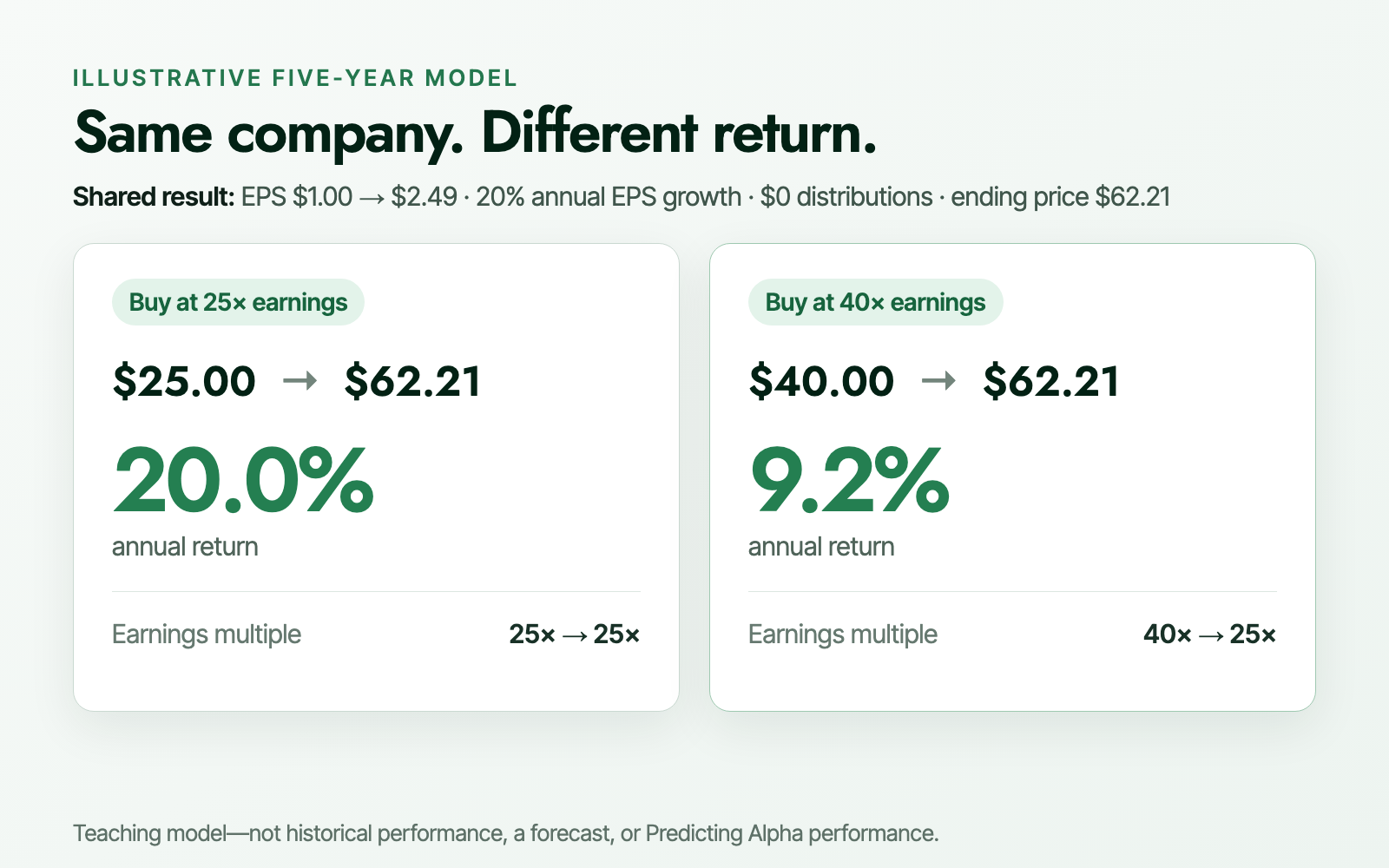
- Ending share price: about $62.21
Only the purchase price changes.
Buy at 25 times earnings. You pay $25 per share. Five years later, the shares are worth $62.21. Because the earnings multiple stayed at 25, your annual return matches the 20% annual growth in earnings per share.
Buy at 40 times earnings. You pay $40 per share. You own the same company, receive the same business performance, and finish at the same $62.21 share price. Your annual return is about 9.2% because the fall from 40 times earnings to 25 times absorbed much of the operating growth.
The second investor didn't lose money. But an investment returning 9.2% may still be disappointing if the original thesis required a much higher return, the risks were substantial, or a better opportunity was available.
Now change the ending valuation as well. If the 40-times buyer gets the same earnings growth but the company finishes at 20 times earnings, the ending price is about $49.77. The annual return falls to roughly 4.5%. If the valuation stays at 40, the return is 20% a year. Same earnings, very different outcomes.
This comparison doesn't prove that 25 times earnings is cheap or 40 times is expensive. A low multiple can fall further, and a high multiple can be justified by a long period of exceptional growth. The model shows where the return has to come from and how much your outcome depends on what another investor may pay later.
“Buy quality” leaves out the price
I understand the appeal of buying the best business you can find and holding it for a long time. Exceptional businesses can reinvest a dollar today and create much more than a dollar of value over time. They can protect margins, fund growth without dangerous borrowing, and keep finding attractive places to put capital.
Those qualities can justify paying a premium. A business that compounds per-share cash flows for much longer than expected can make an apparently expensive purchase look sensible in hindsight.
The problem is turning “quality” into permission to pay any price.
If the valuation already assumes years of near-perfect execution, even a very good result may not be enough. Your downside doesn't require the company to become bad. Growth can slow from exceptional to merely strong. Reinvestment opportunities can become less attractive. Investors can decide that a lower multiple fits the company's more mature future.
The opposite mistake is buying the lowest multiple without asking why it is low. A company can look cheap while its economics deteriorate, debt becomes harder to manage, or the business loses the ability to reinvest profitably. A falling price does not create value if the cash flows are falling faster.
Quality matters because it shapes the cash the business can produce, how long it can grow, and how much uncertainty surrounds that result. Price matters because it determines how much of that future you receive for each dollar invested. We need both parts.
Turn admiration into an investable thesis
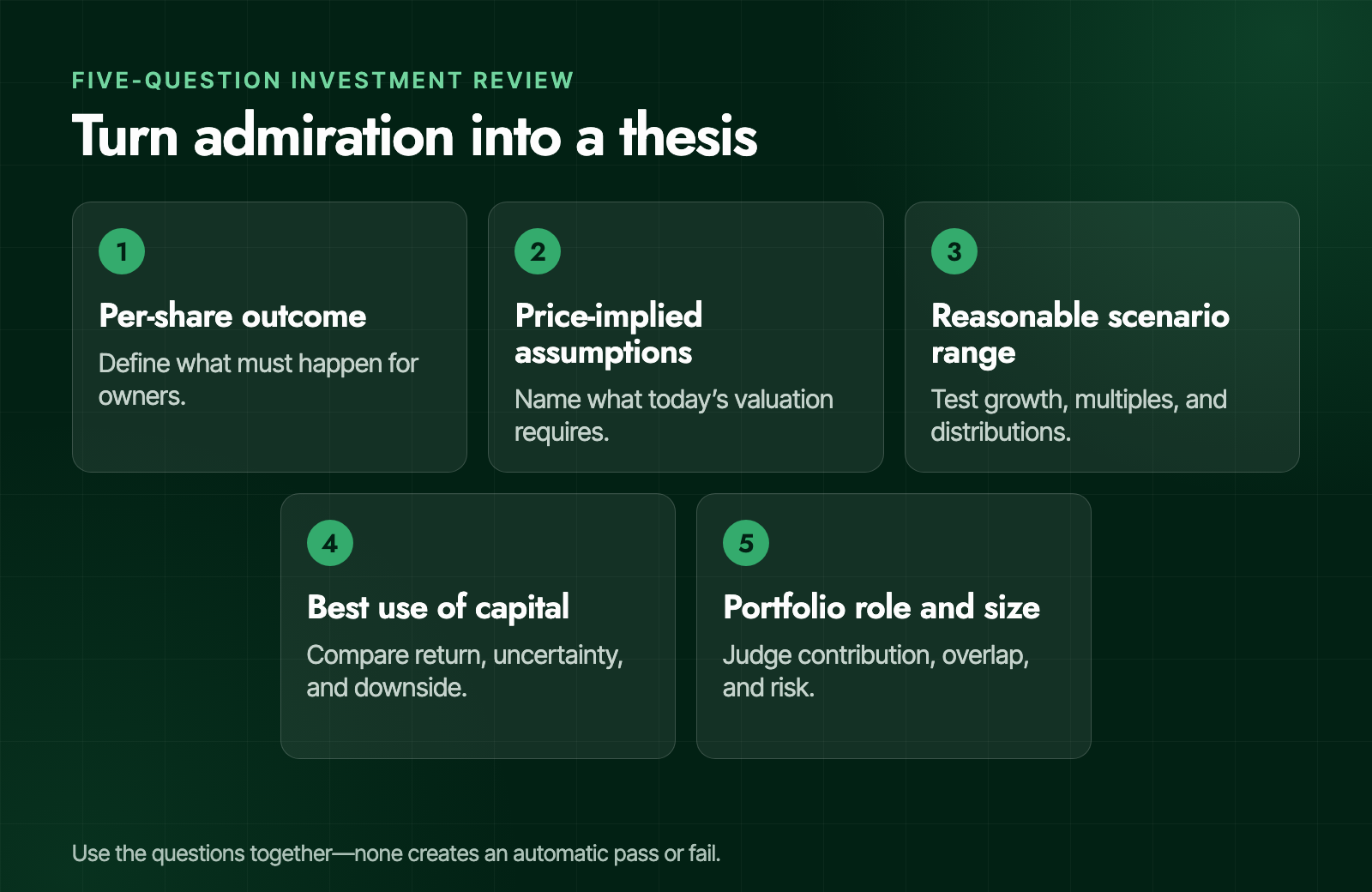
Before I decide that a great company deserves capital, I want five questions answered.
- What has to happen per share? Define the growth in earnings, free cash flow, or another relevant owner measure. Include the effects of likely dilution, buybacks, and financing rather than relying on company-wide revenue growth.
- What does today's price appear to require? Write down the growth rate, margins, reinvestment runway, and durability needed to make the valuation sensible. You won't know the market's exact assumptions, but you can identify the future your own purchase depends on.
- What happens across a reasonable range? Test slower and faster growth, then combine each with a lower, similar, and higher ending multiple. Add expected distributions. The point isn't to predict one price five years from now. It's to see which assumptions have to carry the return.
- What else could the capital do? Compare the prospective return, uncertainty, and downside with the opportunities actually available to you. A good investment can still be the wrong use of capital when a better one is available.
- What does the position do to the portfolio? Decide whether the expected contribution justifies the risk and what position size keeps a wrong thesis from doing unacceptable damage. A company can pass the valuation test on its own and still duplicate risks you already own elsewhere.
If you want to see how these decisions fit into a practical investing process, I explain our approach in my free book, The 5-Minute Hedge Fund.
Decide in advance what would prove you wrong
A falling share price doesn't tell you which part of the thesis failed. The business may be performing as expected while the valuation falls. The share price could also hold up while the business weakens because investors temporarily pay a higher multiple.
Monitor the assumptions that made the investment attractive in the first place. Depending on the company, a thesis breaker could be damaged unit economics, shrinking reinvestment opportunities, persistent dilution, more leverage than the business can comfortably support, or per-share growth that falls below what the purchase price required.
Then separate two diagnoses.
The business thesis is weakening. The company is less likely to produce the per-share results you expected. Your estimate of future cash flows needs to change.
The original valuation was too optimistic. The company may deliver the operating result you expected, but your expected return relied on an ending multiple that no longer looks reasonable. The business can remain excellent while the investment case weakens.
Making that distinction won't remove uncertainty. It will stop you from treating every price decline as proof that the company is broken, or every good earnings report as proof that the shares are attractive.
You aren't buying a company's reputation in isolation. You're buying a stream of uncertain per-share results at a specific price. Admiration can start the research. The expectations in the valuation, the return available against other choices, and the position's role in your portfolio have to decide whether the investment deserves your capital.
Hey, I'm Sean. I run Predicting Alpha, where I help people beat the market without turning it into a second job. I've helped 3,000 traders, and I write these articles to explain what matters for your portfolio in plain language.
If you found this useful, follow along. I share more like this here.
P.S. I reply to all comments personally, so feel free to leave your questions below.