One Stock Made You Wealthy. How Much of Your Future Should It Control?

On this page
A stock that started as 10% of your portfolio can quietly become 30%, 50%, or more after years of strong returns. That's the kind of problem investors hope to have. It also creates one of the hardest decisions in investing.
Selling can feel like turning against the company that made you wealthy. You may still believe in the business. You may face a large tax bill. And if the stock keeps climbing after you sell, every trimmed share will look like a mistake.
Keeping it all feels easier until you ask what one bad outcome would do. The money may now represent your retirement, your family's security, or the freedom to stop working on someone else's schedule. One company has become responsible for goals that never depended on it when you first bought the shares.
The useful question isn't whether the stock will rise next year. Nobody can give you that answer reliably.
How much of your future are you willing to make dependent on one company?
That question gives us something we can actually work with.
Separate a great company from a safe position
You can be right about a business and still own too much of it.
A company's products, management, and financial strength help you judge the investment. Your spending needs, income, other holdings, and tolerance for a permanent loss help you judge the position size. Those are different decisions.
This distinction matters because concentration often arrives without a deliberate choice. A holding appreciates faster than everything else and becomes a larger share of the portfolio. Employer shares can add another layer because the same company may provide your salary, bonus, and stock-based compensation. FINRA's discussion of concentration risk highlights both appreciation and employer stock as common ways investors become more concentrated than they intended.
None of this says the stock is due to fall. Concentration changes the consequence if something goes wrong. A broad market decline can hurt a diversified portfolio too. Diversification can't prevent losses. What it can do is reduce the amount of your future that depends on one company's product failure, accounting problem, competitive shock, regulation, or management decision.
That's why volatility and permanent loss deserve separate attention. A temporary price swing is uncomfortable. A lasting impairment in the business, or a forced sale while the price is down because you need the money, can change what the portfolio is able to fund.
Measure the dependence you actually have
Start with the obvious number: the stock's share of your investable assets. Divide the position's current value by the value of the portfolio you could realistically allocate elsewhere.
Then widen the view. A 25% position can create more than 25% dependence when the company is tied to the rest of your life. Work through these five questions:
- How much of your investable portfolio is in the stock? Include shares held across taxable accounts, retirement accounts, and any vehicles you control.
- How much of your total net worth does it represent? Your home and private business may matter to the full picture, even if they aren't easy to sell or rebalance.
- Does the same company pay you? Salary, deferred compensation, unvested shares, and future grants can all suffer around the same time as the stock.
- Which goals need this money soon? A house purchase in two years has less time to recover from a company-specific loss than retirement spending planned for 20 years from now.
- What changes if the position suffers a lasting loss? Name the goal, the dollar shortfall, and the extra years of saving or work it could require.
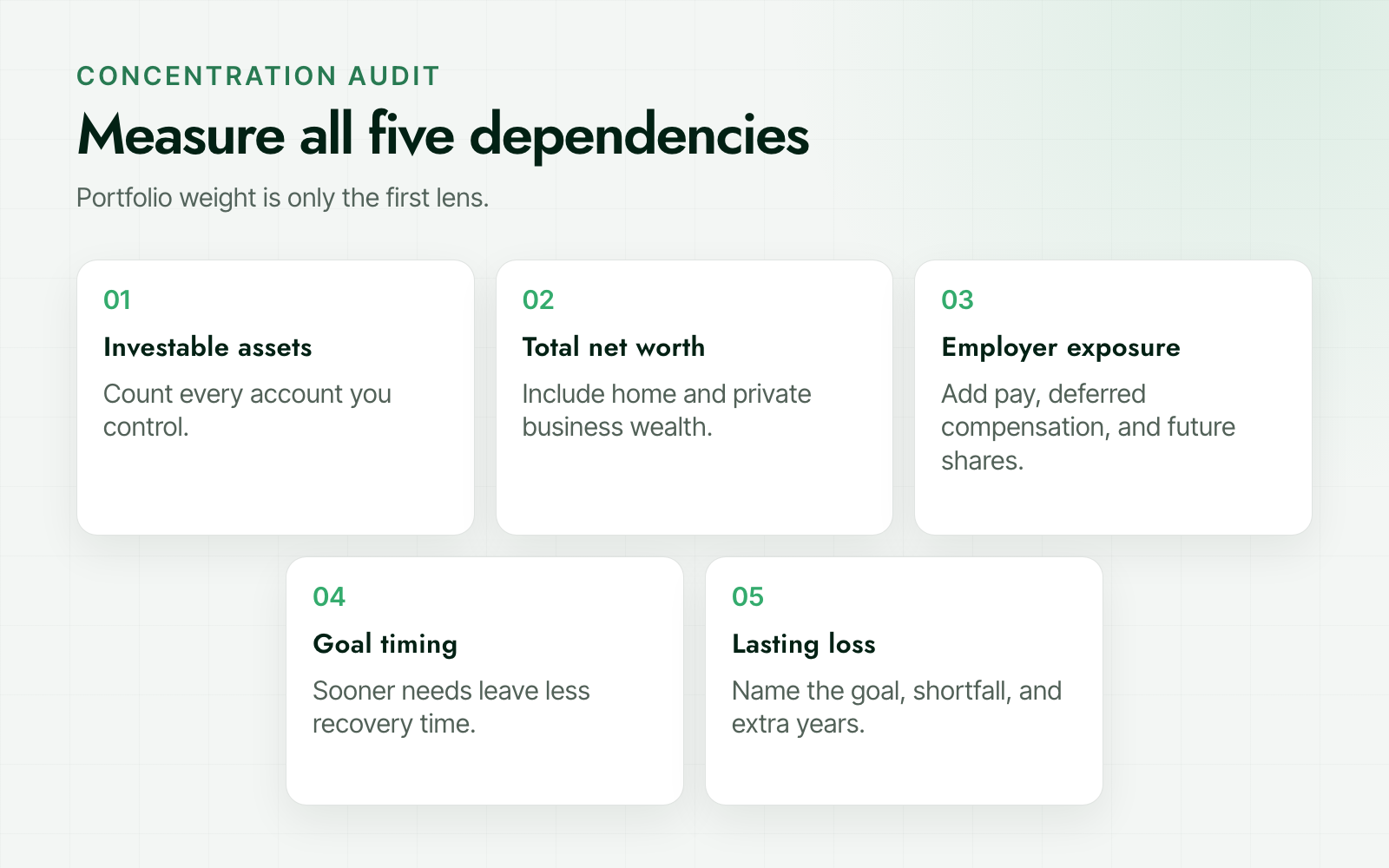
The last question does the most work. “I can handle a 40% drop” can mean you wouldn't panic when the quote turns red. It doesn't tell us whether you could still fund the life the money is for.
Put the stakes into dollars and years
Say you have a $4 million investable portfolio, including $2 million in one stock. You want at least $3.2 million set aside before stepping back from work, and you're adding $100,000 a year to the portfolio.
We'll hold every other investment flat for the moment. That isn't a forecast. It lets us isolate what the one position can do to the plan.
- If the stock falls 35%, the position loses $700,000. The portfolio falls to $3.3 million, a 17.5% decline. You still sit just above the $3.2 million amount.
- If the stock falls 60%, the position loses $1.2 million. The portfolio falls to $2.8 million, a 30% decline. You're $400,000 short. At $100,000 of annual additions and no investment growth, closing that gap takes four years.
- If the stock falls 80%, the position loses $1.6 million. The portfolio falls to $2.4 million, a 40% decline. The $800,000 gap represents eight years of additions under the same simple assumptions.
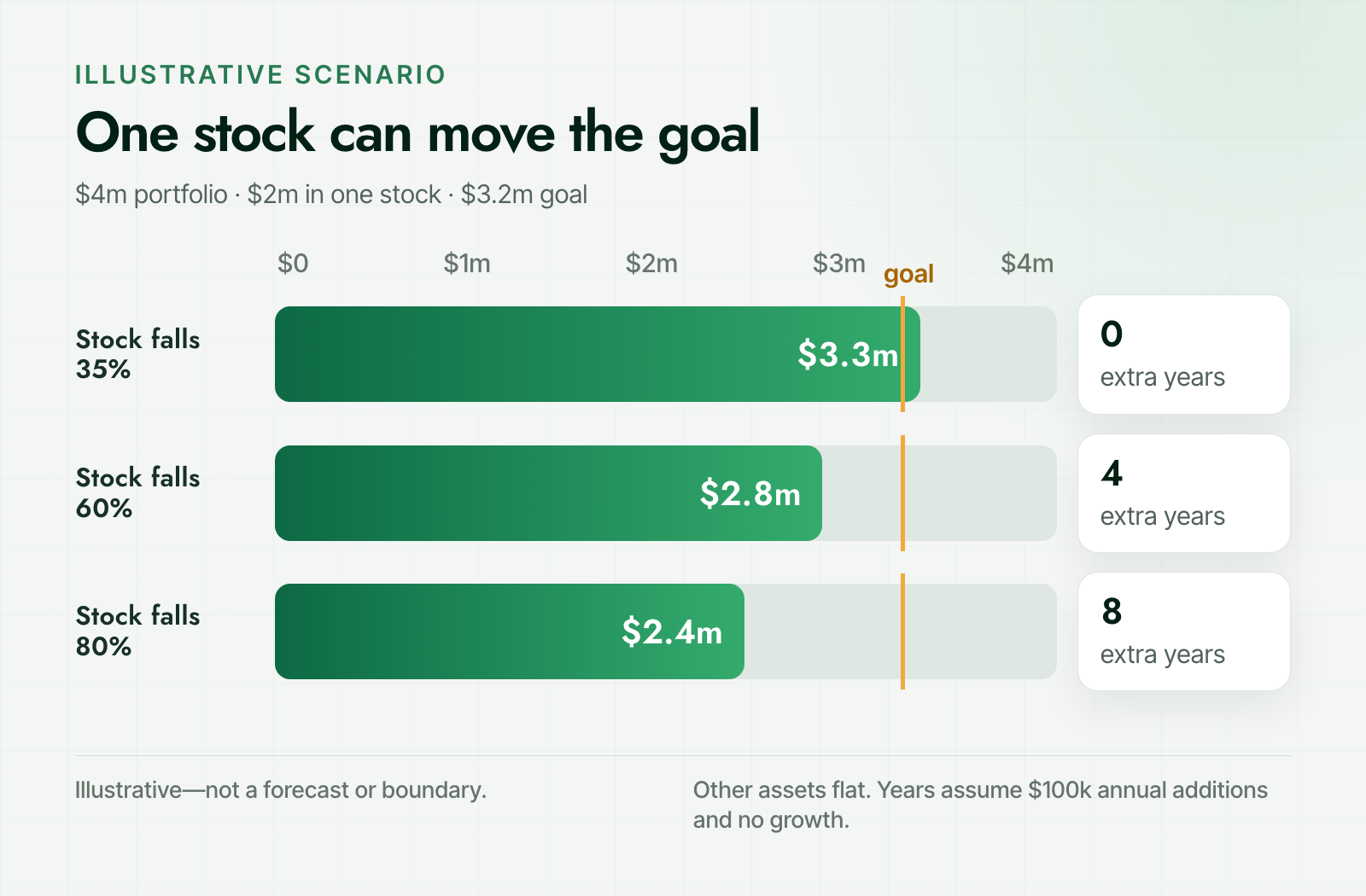
Those aren't predictions or boundary lines. The stock could do better, worse, or recover quickly. The calculation shows how a company-level outcome reaches a life goal.
Now look at the upside you would retain at smaller sizes. If the stock doubled while everything else stayed flat, a 50% position would add $2 million to the portfolio. A 30% position would add $1.2 million. A 15% position would add $600,000.
The smaller positions still participate in a terrific result. They give up some upside in exchange for reducing the damage from a bad one. With a 60% stock decline, those same position sizes would cost the portfolio $1.2 million, $720,000, and $360,000 respectively.
This is the tradeoff. You aren't choosing between belief and disbelief. You're choosing how much of both the upside and the downside your plan will carry.
Let required goals set the limit
There is no concentration percentage that fits every investor. A universal rule ignores what the money needs to do.
I would start by separating required goals from optional ambitions. Required goals are the spending you aren't willing to put at the mercy of one company: near-term taxes, a home purchase, education costs, a basic retirement income, or a safety reserve. Optional ambitions might include retiring earlier, leaving a larger estate, or funding a bigger lifestyle.
Then ask how much loss the required plan can absorb. If a severe company-specific loss would force you to delay an essential goal, reduce spending you consider non-negotiable, or sell other assets at a bad time, the position is carrying more responsibility than your plan can safely give it.
Your other exposures matter too. An investor with stable income from an unrelated source and years before any withdrawals can carry more uncertainty than someone whose job, benefits, and portfolio are tied to the same company. A large cash reserve can cover near-term spending, but it doesn't erase the risk to long-term capital.
This is also where diversification has to be understood honestly. The SEC's Investor.gov guide explains diversification as spreading money among investments to reduce risk. It also makes clear that diversification can't guarantee against a loss. You are reducing company-specific dependence, not buying immunity from bad markets.
A defensible concentration limit is the largest position that still leaves your required goals workable after a severe, lasting loss. You may choose to accept more concentration for optional upside. Just don't let optional upside quietly become responsible for essential spending.
If you want to see how portfolio decisions fit together, I explain our approach in my free book, The 5-Minute Hedge Fund.
Choose a transition you can follow
Once you know the current weight and the weight your plan can carry, you still have to get from one to the other. Waiting for the perfect price turns the decision back into a forecast. A transition rule is more useful.
Reduce it now. An immediate sale removes company-specific dependence fastest. It also realizes any taxable gain now and gives up the most near-term upside if the stock keeps rising. This approach fits an investor whose essential goals are already exposed beyond an acceptable level and who values getting the risk down promptly.
Sell in stages. You can divide the reduction across dates or predetermined position thresholds. This lowers dependence more slowly and leaves more exposure during the transition. It can make a large decision easier to execute and may spread realized gains across tax periods, though the actual tax result depends on your jurisdiction and circumstances.
Direct new money elsewhere. Dividends, savings, bonuses, and proceeds from other sales can go into the rest of the portfolio. You avoid selling the concentrated shares, but the position may remain dominant for years. If it keeps appreciating faster than the new money arrives, its weight can rise despite your efforts.
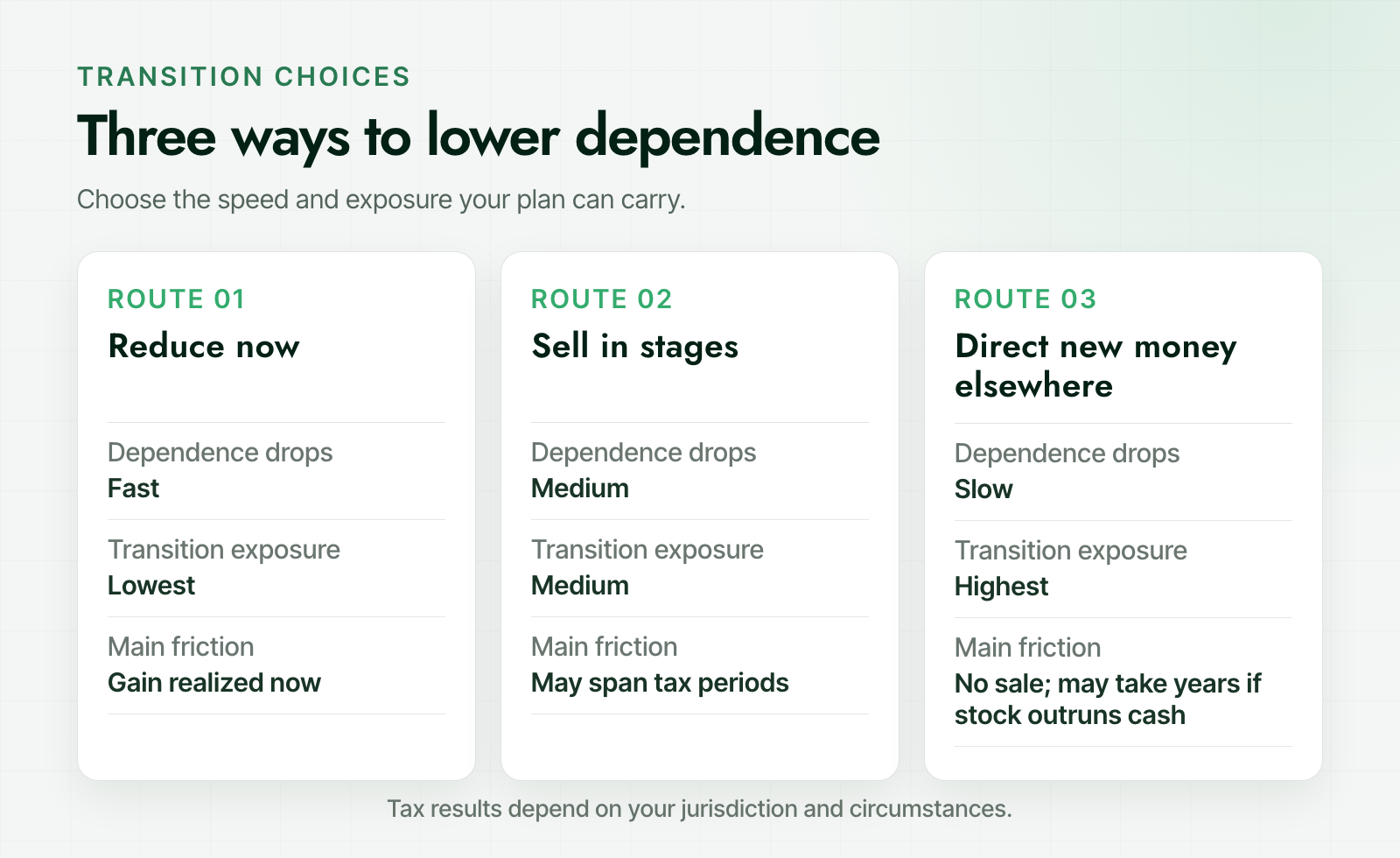
Taxes belong in the decision because they affect how much wealth remains after a sale. They shouldn't end the analysis. Compare the known cost of realizing a gain with the financial consequence of keeping the exposure. Tax rates, account rules, cost basis, charitable plans, and estate treatment vary, so this is where qualified tax and financial advice specific to your situation matters.
You can also combine the approaches. An initial sale can remove the amount that threatens required goals, staged sales can handle the remaining excess, and new cash can build the rest of the portfolio. The right transition is the one that reduces the dangerous dependence quickly enough and is realistic enough that you'll carry it out.
Turn the decision into a standing policy
The stock's latest move shouldn't rewrite your plan. Put the rule in writing while you can think about it calmly.
Your policy only needs a few parts:
- A target range. Set a range rather than pretending you can maintain one exact percentage every day.
- Review triggers. Review after a major price move, a change in employment, a new financial goal, a large tax change, or a material development in the business.
- A rebalancing rule. State what happens when the position moves above the range, including how much you sell and whether the action is immediate or staged.
- Narrow exceptions. Define what could justify a temporary exception, who is involved in the decision, and when you must review it again.
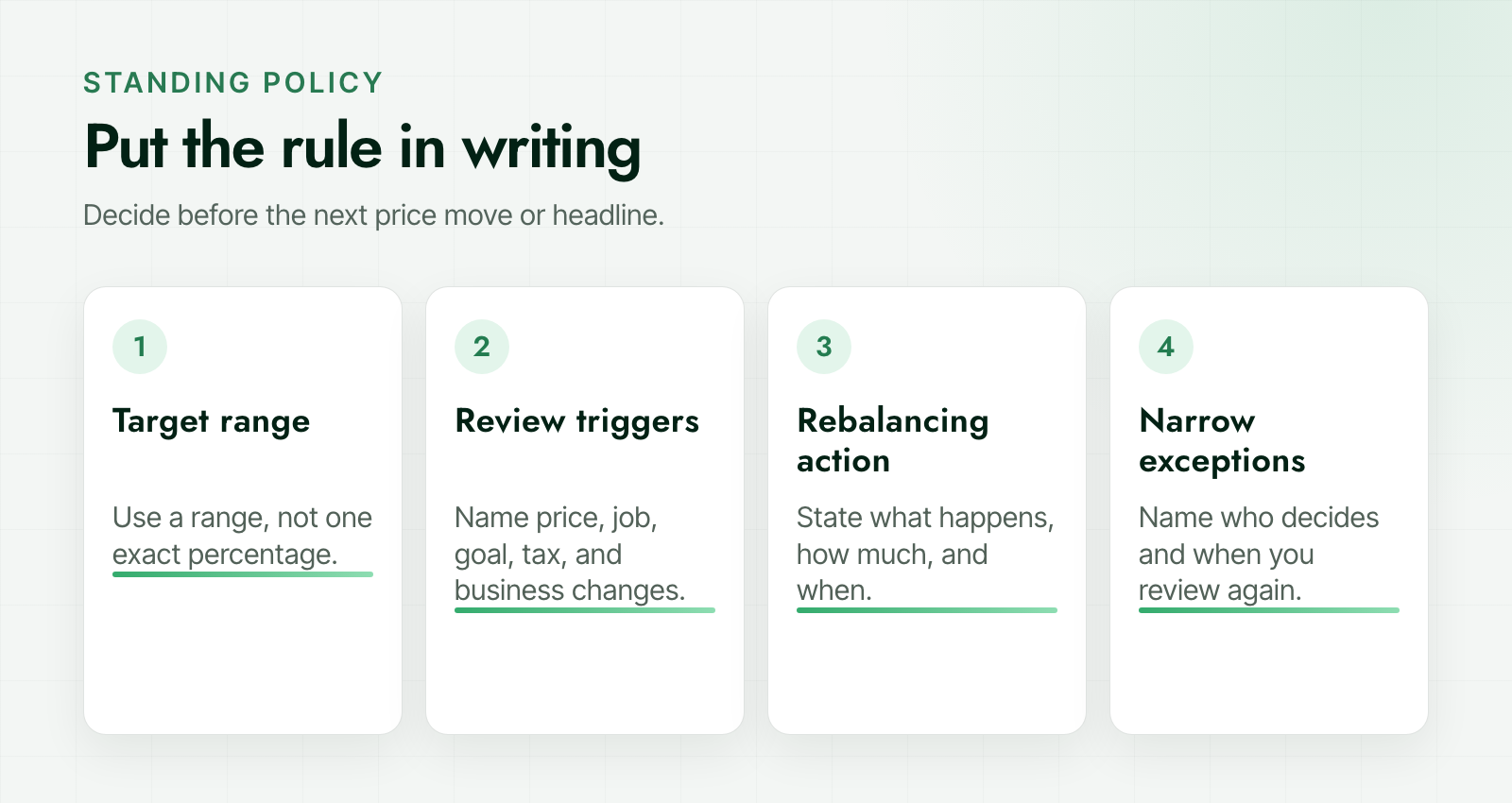
A useful policy can be as plain as this: “Keep Company X between 20% and 25% of investable assets. Review quarterly and after any move above 30%. Direct all new contributions elsewhere. If the position finishes a review above 25%, sell it back to 25% within 30 days, subject to a tax review.”
The figures are just an example. The strength is that the decision no longer depends on whether the latest headline makes you excited or afraid.
The stock that created your wealth deserves respect for what it did. It doesn't automatically deserve control over the life that wealth is meant to fund. Keep enough to participate in the upside you still believe in, if that fits your plan. But set the position so one company can't take essential goals down with it.
Hey, I'm Sean. I run Predicting Alpha, where I help people beat the market without turning it into a second job. I've helped 3,000 traders, and I write these articles to explain what matters for your portfolio in plain language.
If you found this useful, follow along. I share more like this here.
P.S. I reply to all comments personally, so feel free to leave your questions below.