You Don’t Need Dividend Stocks to Live Off Your Portfolio

On this page
A lot of retirement advice starts with a rule that feels almost sacred: spend the dividends and never touch the principal.
I understand the appeal. Cash arrives without you choosing what to sell. Your share count stays intact. It feels as though the portfolio is paying you while the investments themselves remain safely out of reach.
But your share count isn't your principal. It tells you how many units you own, not what those units are worth, what they can buy, or how long they can support your spending.
You can own the same number of shares after their value falls 30%. You can also own fewer shares after a planned sale and have more money than you started with. Inflation, fees, taxes, investment returns, and withdrawals all matter more to your financial life than whether the number of shares changed.
The useful question is not, “Can I avoid selling?” It is:
Can my portfolio and withdrawal policy support the spending I need through good markets and bad ones?
Once we ask that question, dividend income becomes one way to produce cash, not a separate source of wealth.
Look at the whole return, not just the cash payment
An investment can reward you in two ways. Its market value can change, and it can make cash distributions such as dividends. Together, those make up its total return, as defined in the Investor.gov glossary.
Suppose a $100 investment rises to $106 and pays no dividend. Its total return is 6%. If another investment finishes at $102 after paying you $4, its total return is also 6% before costs and taxes.
The $4 dividend didn't appear from nowhere. The company transferred cash it owned to its shareholders. All else equal, that leaves less value inside the company. This is why market procedures account for distributions. For example, FINRA Rule 5330 requires certain open orders to be adjusted when a security trades ex-dividend.
Of course, market prices move for many reasons at once, so you won't always see a stock close at one price and open lower by the exact dividend. The economic point is simpler: count the cash and the remaining investment value together. A distribution is part of your return, not extra return on top of it.
That gives us a fair way to compare receiving a larger dividend with selling a small part of a lower-yielding portfolio.
Two portfolios can fund the same $20,000
Say two investors each start with a $500,000 portfolio and need $20,000 at the end of the year. To isolate the cash-flow mechanism, both portfolios earn the same 6% pre-tax total return. There are no fees, and each starts with 10,000 portfolio units worth $50.
The returns are split differently.
The 4%-yield portfolio pays a $2 distribution per unit, giving the investor $20,000 in cash. The remaining unit value finishes at $51. The investor spends the distribution, keeps all 10,000 units, and ends with a portfolio worth $510,000.
The 1%-yield portfolio pays a $0.50 distribution per unit, giving the investor $5,000. Its remaining unit value finishes at $52.50. The investor sells about 285.714 units for the other $15,000, leaving about 9,714.286 units worth $510,000.
Here is the full reconciliation:
- Both start with $500,000.
- Both earn $30,000, or 6%, before the withdrawal.
- Both provide $20,000 of spending cash.
- Both finish with $510,000 invested.
- One investor has 10,000 lower-priced units. The other has fewer, higher-priced units.
This is a constructed one-year comparison, not historical performance or a forecast. Real investments won't produce matched returns on command, and trading costs, taxes, and the timing of distributions or sales can change what the investor keeps.
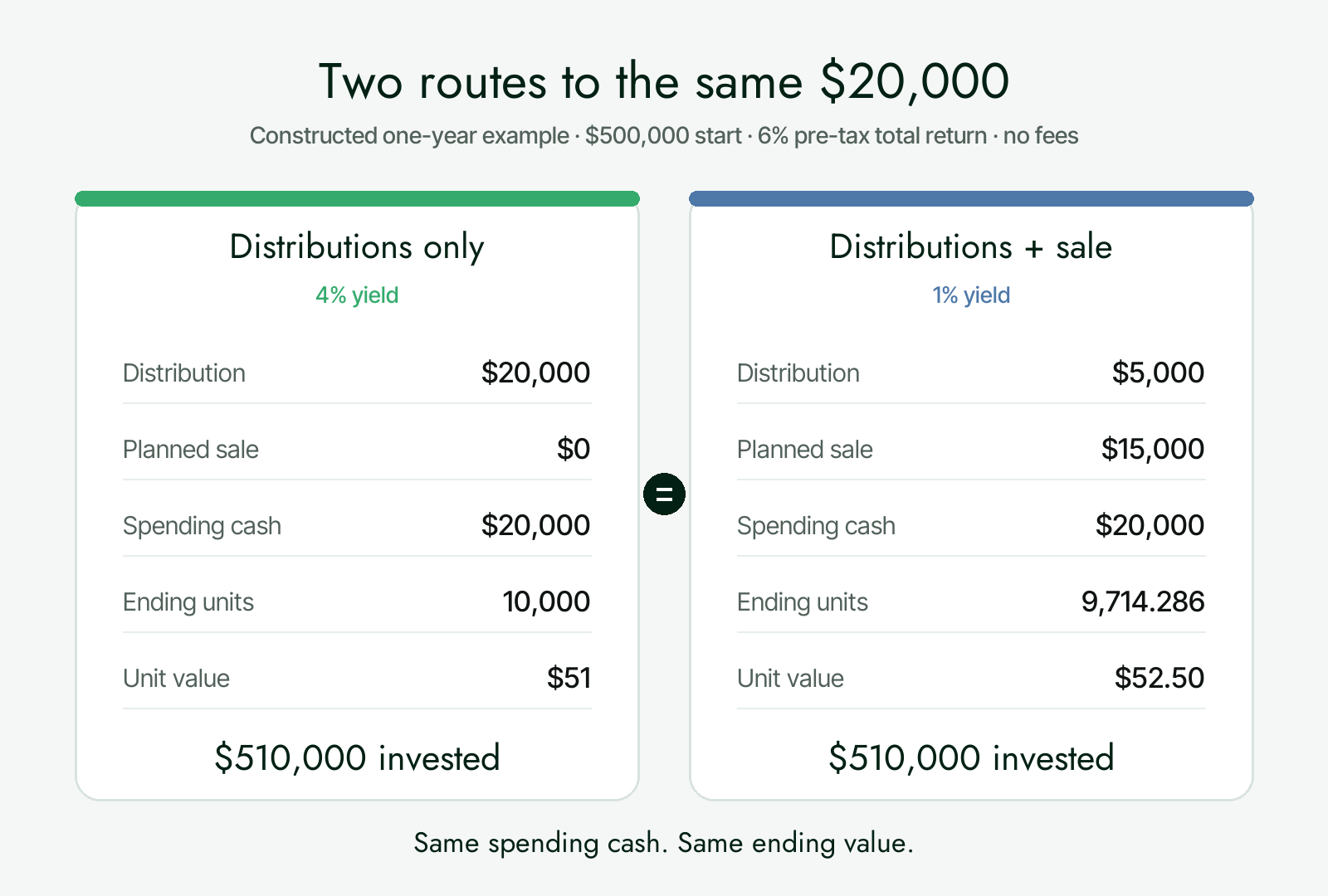
Still, the example proves the narrow point we need: selling units did not make the second investor poorer than the first. With matched total returns and cash flows, both investors ended in the same financial position before the omitted costs and taxes.
Share count by itself hid that result. Portfolio value revealed it.
A high yield cannot make an unsustainable withdrawal safe
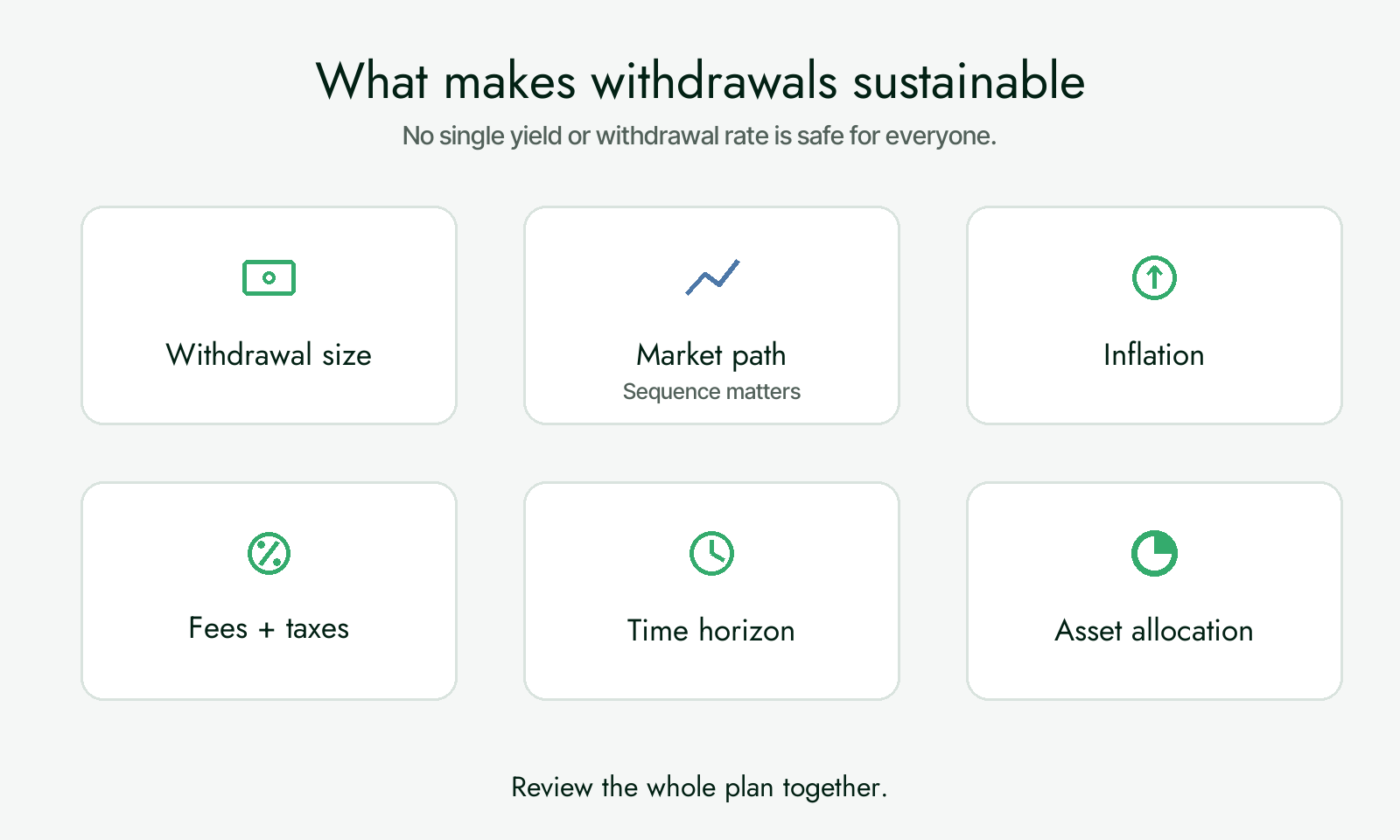
Now move beyond one tidy year. The sustainability of your spending depends on how much you withdraw, how long the money needs to last, inflation, costs, taxes, your mix of investments, and the path markets take along the way.
That last part matters because spending continues when markets fall. If you withdraw from a portfolio after a large loss, less money remains to participate in a recovery. This is called sequence-of-returns risk. Averages can hide it because two investors can experience the same returns in a different order and finish with very different amounts once withdrawals are involved.
Dividends don't remove that risk. Companies can reduce or suspend them. A fund may distribute cash while the value of your holding falls. And if the portfolio's distributions don't cover your spending, you still need another source of cash.
Imagine a $500,000 portfolio yielding 7%, or $35,000 a year. If you spend $50,000, the high yield hasn't solved the $15,000 gap. If the portfolio also loses value, insisting that you “never sell” doesn't repair the plan. It only changes where you look while the portfolio supports a withdrawal it may not be able to sustain.
There is no dividend yield or withdrawal percentage that is safe for everyone. A spending rate that works for one investor can be wrong for another because their time horizons, flexibility, taxes, other income, and portfolio risks differ.
Chasing income can quietly change what you own
Once an investor decides the portfolio must produce a certain yield, the search can push every other goal into the background.
You may end up concentrating money in the sectors and companies that currently make larger distributions. You may pass over investments that could improve diversification because their return arrives mainly through price appreciation. And you may accept a weak business or an expensive security because its quoted yield looks attractive.
A high yield can even be a warning rather than a gift. If a stock's dividend stays unchanged while its price falls from $50 to $25, its yield doubles. Your income didn't grow. The market value supporting that income was cut in half, and the market may be pricing in trouble ahead.
None of this makes dividend-paying companies bad investments. The mistake is treating yield as the portfolio's main objective when the investor actually needs growth, diversification, liquidity, and dependable spending over many years.
I would rather start with the whole job. What return does the plan need? What losses can the investor live through without abandoning it? How much money must be available soon? Which mix of investments gives the plan a reasonable chance without relying too heavily on one company, sector, or type of return?
Yield belongs inside that analysis. It shouldn't replace it.
If you want to see how these portfolio decisions fit together, I explain our broader approach in my free book, The 5-Minute Hedge Fund.
Turn total return into spending you can use
A total-return approach still needs an operating system. “Sell when you need money” is too vague, especially when markets are moving quickly and every decision feels urgent.
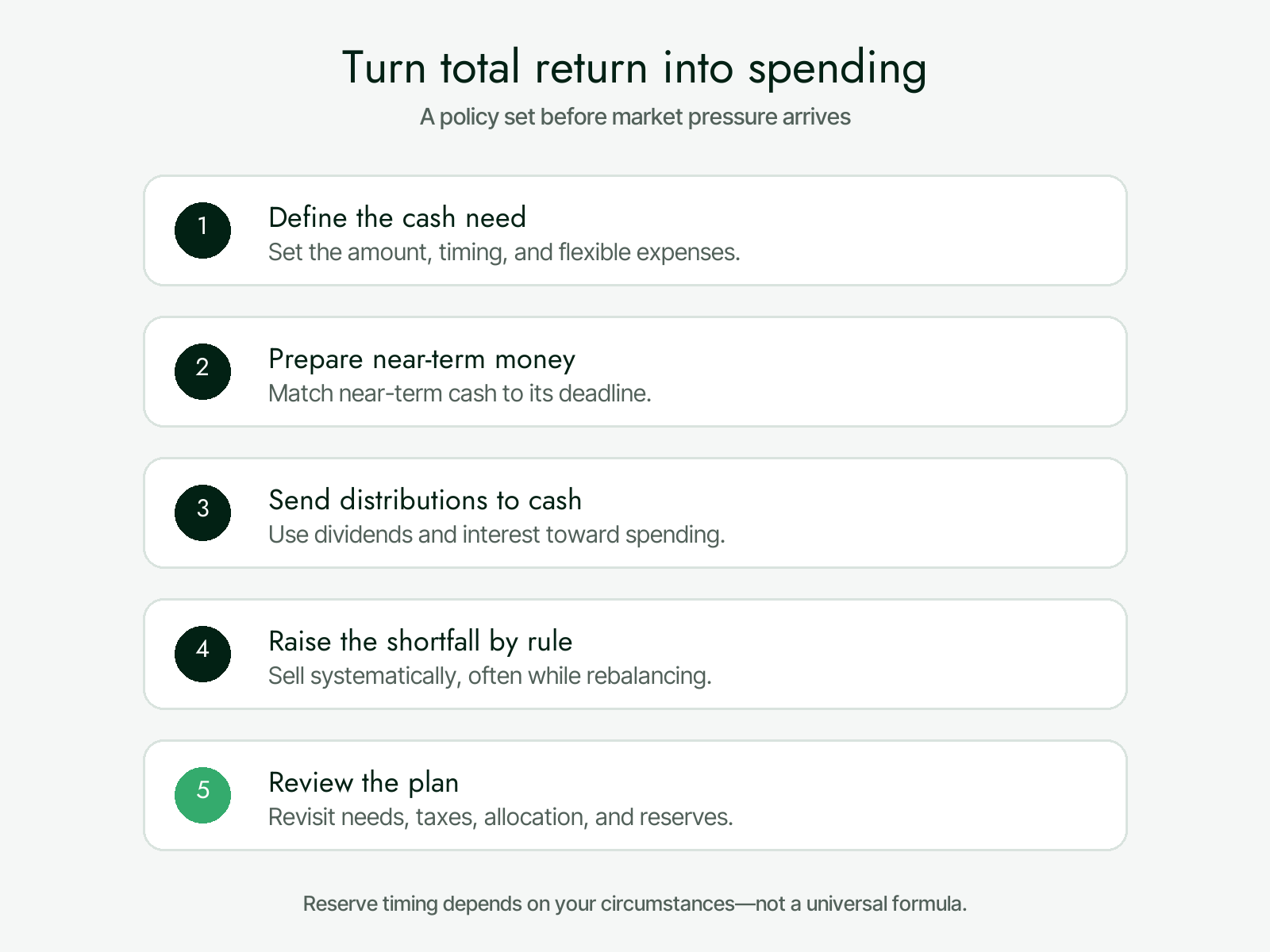
A practical policy can work like this:
- Define the cash need. Work out how much spending the portfolio must fund, when the money is due, and which expenses could be reduced during a difficult period.
- Keep near-term money appropriate for its deadline. Money needed soon shouldn't depend entirely on selling a volatile investment at a favorable price. The right reserve depends on your circumstances, not a universal number of months or years.
- Send distributions to cash. Use interest and dividends toward the next withdrawal instead of automatically reinvesting them when you already need cash.
- Raise the shortfall by rule. Sell enough to meet the remaining need, often as part of rebalancing the portfolio back toward its intended mix. That turns a withdrawal into a planned portfolio decision instead of a reaction to a headline.
- Review the plan, not every market move. Revisit spending, taxes, allocation, and reserves on a schedule, and make changes when your needs or the plan's condition changes.
The sale rule matters because you don't want every withdrawal to become a guess about which investment will rise next. If one part of the portfolio has grown above its intended weight, selling some of it can fund spending and rebalance at the same time. If markets have fallen broadly, the reserve can cover near-term cash while you decide whether spending or the portfolio needs to change. It cannot erase losses, and it eventually needs replenishing, but it can keep this month's bills from dictating this month's investment decision.
Build some flexibility into the review as well. A plan with spending that can adjust after a difficult run has more room than one whose withdrawals must rise every year regardless of results. That tradeoff belongs in the original plan, before a bad market forces it on you.
Taxes deserve their own attention because a dividend and a sale may not receive the same treatment, and selling can give you some control over which holdings and tax lots are realized. The answer depends on your accounts and jurisdiction. Compare the after-tax cash from each route rather than assuming one is always better.
This policy won't make withdrawals painless in every market. It gives you a process decided before the pressure arrives.
A dividend preference can still be reasonable
You may simply like receiving regular distributions. They can make cash management easier, reduce the number of sale decisions, and help some investors stick with a plan. Those are real practical benefits.
Just keep the claim in proportion. A dividend preference doesn't guarantee the income, create extra return, preserve purchasing power, or protect you from ever having to sell. It is a preference for how some of the portfolio's return reaches you.
You don't need a special category of dividend stocks to live off your portfolio. You need a diversified portfolio built around your goals and a withdrawal policy that converts its total return into spending while accounting for risk, costs, taxes, and uncertainty.
That approach may use plenty of dividends. It just doesn't depend on them doing a job that only the whole portfolio can do.
Hey, I'm Sean. I run Predicting Alpha, where I help people beat the market without turning it into a second job. I've helped 3,000 traders, and I write these articles to explain what matters for your portfolio in plain language.
If you found this useful, follow along. I share more like this here.
P.S. I reply to all comments personally, so feel free to leave your questions below.