Not having trading friends is a mistake

On this page
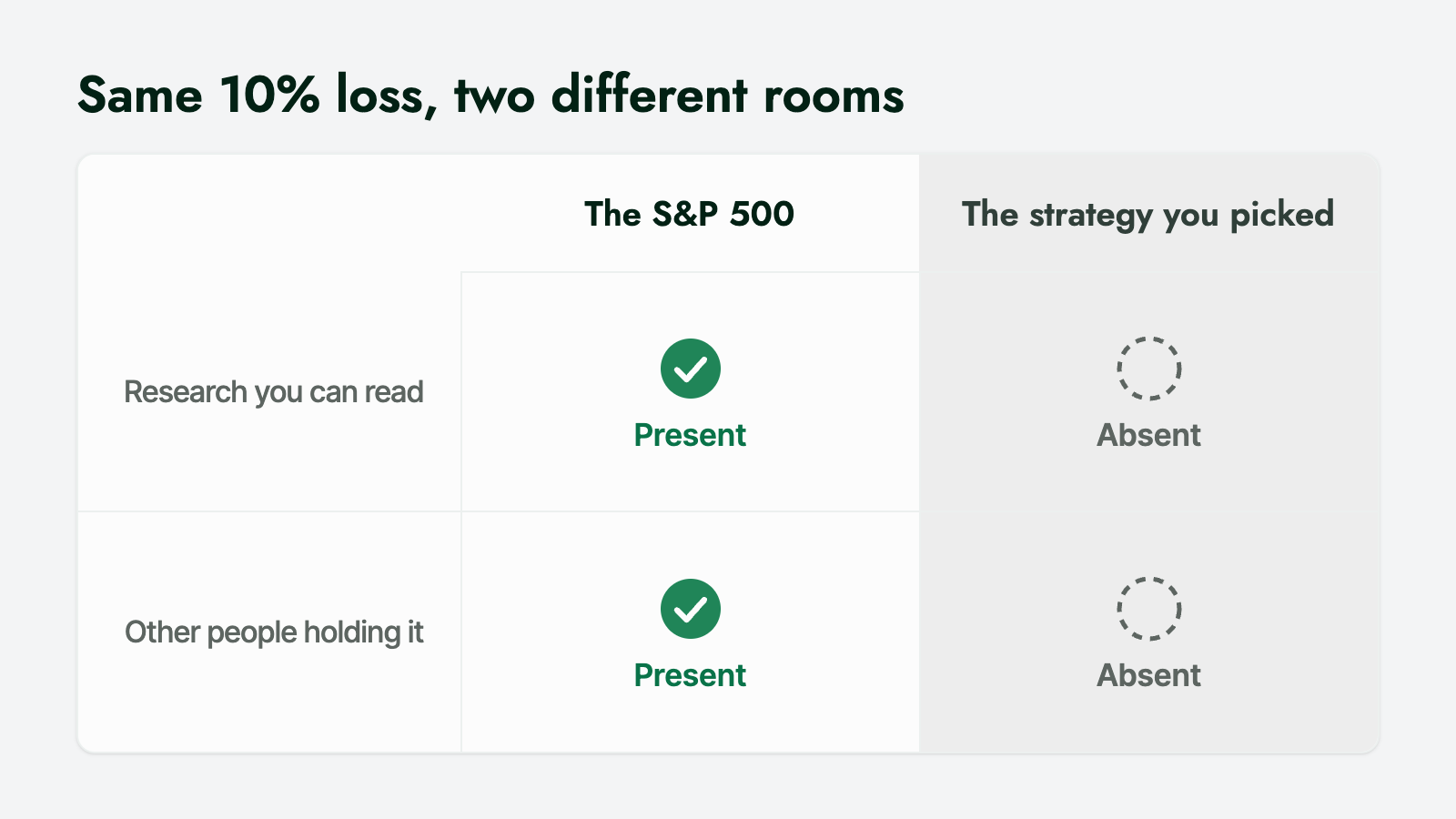
If the S&P 500 fell 10% next month, you would hold it, and so would almost everyone you know. This post is about why that one is easy, and why the same 10% drop in a strategy you picked yourself is agony.
Picture it properly. The index is down 10% over the month, and you walk around asking people whether the S&P 500 will be higher or lower 10 years from now.
Almost all of them say higher. You get that answer on the red day exactly as readily as on the green one.
They can say it because the S&P 500 has been studied to death. The idea that stocks earn a return over long periods is documented so thoroughly that it turned into common knowledge, which is why so much default retirement money just sits in it and nobody loses sleep.
Now look at the other position in the account. The one you chose yourself, down the same 10% in the same month.
That one does not feel the same at all, does it.
That difference has very little to do with your nerve. It sits outside you, and it is made of 2 things. Let's get started.
Nobody stops feeling their own money
The usual explanation here is discipline.
Get better at not reacting. Be cold as ice about your own profit and loss, and the problem goes away.
I think that's a myth, and I think it has done real damage.
You can reduce the problem. You cannot get rid of it. In the end nobody wants to lose money, and no amount of reading we do makes that stop being true.
Here's why it can't be trained away. The hardest part of investing is reconciling what we see in our research with what we see in our live performance.
Research is long historical periods and averages of things. It is clean, and it is theoretical. We are trying to imagine what a bad year would be like.
Live performance is an ever-growing pile of days we personally sat through, and every one of them is attached to how we felt that day.
Those 2 things are hard to reconcile because we have only ever actually experienced one of them.
Why the index is the easy one
Why is the answer to that 10-year question so uniform? 2 things are holding it up, and neither of them is inside anyone's head.
The first is evidence anyone can go and read. Decades of it, on why owning a piece of the world's businesses pays us something over time.
The second is company.
When the index falls 10%, it falls on everybody. Our colleagues, the neighbour, the news, our own retirement accounts. We are visibly not the only one sitting in it.
Look at what happened in 2020. Brokerages reported that retail money came in on net while the market was falling, which was not how retail had behaved in past crashes. Pretty surprising!
People could watch it crashing and still believed the index would be worth more in 10 years.
Now 2 honest limits on that, because I do not want to oversell it.
That conviction has a ceiling. Something like 2008, a 40% to 45% fall that took years to recover, is a different test entirely, and plenty of people failed it.
And the belief gets held without the reasoning. Ask most people why stocks go up over time and the answers get thin very fast.. the fact is common knowledge, but the mechanism is not.
Take the same position into an empty room
Now the same scene with one thing changed.
Imagine you hold the S&P 500, it draws down 10%, and you go out to see what the world thinks about it. There is nobody there.
No articles, no colleagues, no neighbour. Just you, the chart, and whatever you can remember of the research.
Nothing about the index has changed. You know exactly what you knew a minute ago.
But your stress, your doubt and your uncertainty are all far higher than they are when you can see other people looking at the same research and landing in the same place.
And the odds you shoot yourself in the foot, by closing the position at the worst possible moment for your portfolio, get high.
Now here's the key part for the rest of the account. Every strategy we own that is not a plain index is that empty room by default.
A working strategy and a broken one feel the same
When we start learning about investing we get handed 2 principles. Stick to your strategy. Re-evaluate your strategy and your holdings.
On the surface those sound mutually exclusive. They aren't, and there is a real middle ground. But look at when we are asked to find it.
Right after losing a meaningful amount of money, in a state of high distress, when being objective is the hardest thing in the world.
You end up sitting between chairs with 4 questions going at once. Is this unusual but still normal? Is the strategy still valid? Was it ever valid? Should I do something?
Sometimes the honest answer is that the thing should be stopped. It was a bad idea, or we missed something.
Often, if the way we build strategies is sound, we have a good idea and we just need to stay in it.
But whichever one it turns out to be, the state we are in before we decide is identical. Self doubt, questioning, a spike of stress.
So the feeling itself tells us nothing about which of the 2 situations we are actually in.
What does tell us something is the map.
Example: let's say you run a portfolio and you know it well. You know the spread of returns to expect, roughly how likely a bad drawdown is, which conditions tend to cause one, and what an ordinary day looks like. The worst single day in its entire history is a 2% loss.
Today it lost 3.5%.
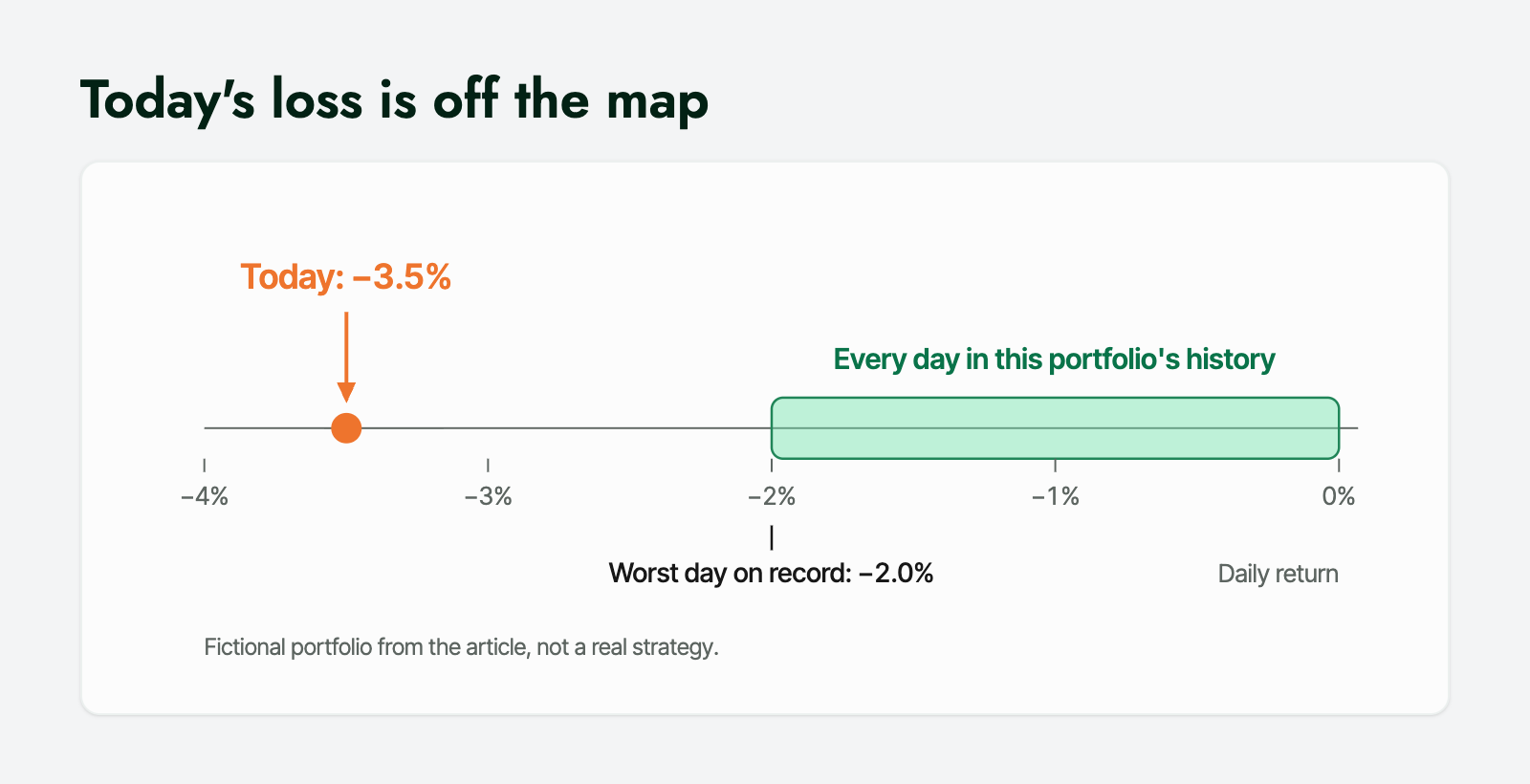
That one is outside the map, so it earns a proper look. Is it possible for this to happen even though it sits outside everything you have seen? Or does it point at a flaw in the assumptions the thing was built on?
Side note: the same goes for a day far better than the strategy should be able to produce. Nobody ever investigates the extra money! Which is a shame, because it is the same signal.
Your aunt and the internet will both give you a useless answer
So who are we supposed to talk to about this?
Take it to a friend, or an aunt, who does not invest, and you get 1 of 2 replies. Either "this sounds dangerous, I don't really know much about it, but better safe than sorry, close everything out and move the lot to cash." Or a pat on the shoulder: "yeah, that sucks, but it'll be fine, keep going."
The retail forum version isn't much better. "Dude, you just have to stick through it."
Not one of those answers looked at anything. They are a mood, handed back to you.
Lawyers don't defend themselves in court. They go and hire another lawyer!
Not because they lack the competence, they obviously have it. They want somebody from the outside who is objective and is not emotionally involved in the case.
That is the arrangement we want for our money, and almost none of us have it.
2 things make a strategy holdable
So what do we actually need in place before serious money goes behind something?
1. Research we can read ourselves. Anything that is a black box is an immediate write-off, whatever the returns look like. A "trust me, here's my Lamborghini" pitch is an automatic no.
And reading it is the job, not just having it.
The further a strategy sits from the pure form of a risk premium, the murkier the information gets, the more assumptions are built into it, and the more testing it needs. So the stranger the thing we are buying, the more of the research we have to get through ourselves.
My summary, after years of watching people try: understand the edge your money is behind as deeply as you can, or good luck sticking with it, and good luck scaling it up.
2. At least one person who can read it with us. Somebody at a similar level of familiarity with that research, or somebody competent to judge it even if they do not run the same thing themselves.
Both are required, and that's the bit people get wrong.
The research on its own does not survive the empty room. We just watched that happen with the index.
And company without the research is only agreement, which is worth nothing in a bad month when everyone in the group chat is guessing too.
The slow grind is the one that gets people
A crash is not the hardest thing to sit through. Everybody is in the same pain at the same time, we know exactly why we lost money, and one glance at a chart explains the whole year.
The stretch that does the real damage is the long one where the market doesn't do much and the account quietly keeps sliding anyway. There's nothing to point at, so finding the reason is much harder, and that's where the doubt actually arrives.
2022 is the public example. The S&P 500 returned negative 18.11%, its worst calendar year since 2008.
But it wasn't an event. The index set its closing high on January 3 and didn't reach its closing low until October 12, about 9 months later.
Its single worst day of the whole year was September 13, down 4.32% after a hot inflation print.
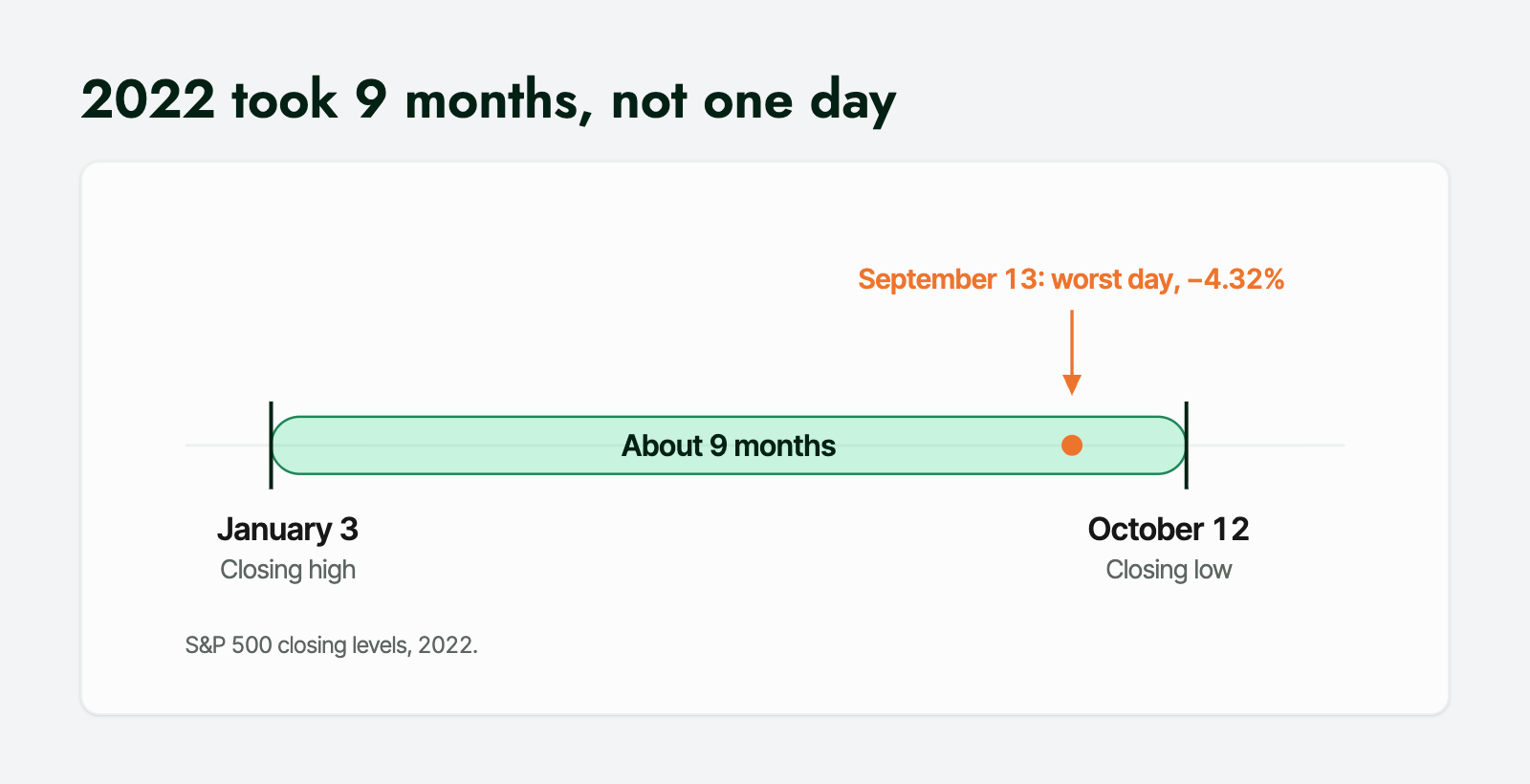
So no single day explains 2022, and we barely even talk about it now. But somebody actively running money the whole way down, sitting 6 months in with another 3 still to go, had a genuinely hard time.
The conviction you need in what your money is behind to stay in through a stretch like that is very high.
Think about Canadian real estate over the last couple of years. If you own a house with a tenant in it, the price going down hurts. That is nowhere near the same as having to go out and buy a house every single day while you lose money for 2 years straight.
Somebody running an active real estate portfolio right now is suffering far more than somebody with a tenant in place, and the market they are both in is identical.
The doctor decides whether the leg comes off
If your leg hurts for a few days, you go and see a doctor. Not because you can't feel the pain yourself, obviously you can. You want a trustworthy outside opinion on what the problem is and what to do about it.
9 times out of 10 the doctor says give it a week, it's probably nothing. The 1 other time he sends you for the scan.
That's what a credible person does for a portfolio. We understand our strategy, we see something odd in the live data, and they help us tell "normal" from "worth examining".. and then help us do the examining.
Most of the time the remedy is leave it alone.
The hard part comes before any of that, and it's ego. Reassessment always shows up right after we lost money, and saying out loud that you're down and unsure takes real courage while everyone online is posting a green screenshot.
It is not an admission of failure. Most of the time it's variance and you did nothing wrong.
Among the people I know outside my own investing circle, I hear about it whenever the market is up 5%. On red days, crickets. Zero conversation, which is backwards, because the red day was the one with the better conversation in it.
And that is what the leg is really for. The people around us help us decide whether we leave it alone or whether it has to come off. Because if your leg hurts and you panic and amputate it yourself, the doctor is going to say it was a bruise, and I can't put the leg back on now.
So, those 2 positions
Both down 10% in the same month. One has decades of published evidence behind it and most of the investing world holding it alongside us. The other has us.
That's the whole difference, and it was never willpower. If you panicked out at the bottom of something once, you weren't weak. You were unsupported.
So before any more money goes behind anything, get 2 things. The research in a form you can actually sit down and read, and one person who can read it with you and tell you whether what you are seeing is normal.
I hope this is useful, because it's the part of investing nobody sells you and everybody needs. If you think I have this wrong, say so in the comments, I would like to hear it.
If you recognised yourself in here, that's roughly why we run Predicting Alpha the way we do. Our research is published, so you can read what your money would be behind before any of it goes in.
Members get one model portfolio run by fixed rules, they see what the account should hold, and they get an alert with instructions when something needs to change. There is also a letter from me after Friday's close on how the portfolio did, so nobody sits through a quiet stretch wondering alone what just happened. I run my own money in the same portfolio.